

The Four Elements Epistemic Model (prototype)
A framework meant to help people understand one another from across different cultures and ways of knowing


An Invitation to Dialogue
What follows is a hypothesis—a proposed framework for understanding how we come to know what we know. It is not a final answer but an offering for rigorous examination and critique, particularly with future audio episodes and corresponding discussions meant to unpack all of this to invite shared discourse. This framework has been implicitly guiding my thinking since I (Eric) started this podcast (see the very bottom to learn how this model is actually represented in the core visual for this Negotiating Reality space). This is also a rough draft starting point of a roadmap that I plan to make the core focus of Season 2 of Negotiating Reality. I’m putting it out now as I’ve been increasingly asked by some listeners, back channel, to be even more transparent and explicit about my epistemic assumptions to help provide a structure for understanding the metaphysical and teleological claims that are being explored right now in Season 1 of the podcast. As I flagged previously, this is very much a chicken-and-egg issue whereby all of these explorations into facets of a worldview (the nature of reality, orientations around meaning/purpose, descriptions on how we know what we know, and understanding on being, becoming, and doing) are referential to one another and thus, even when focusing on one facet of a worldview, all the other facets need to be brought in, at least in a cursory way, to enable understanding.
This framework organizes four complementary ways of engaging reality along two fundamental dimensions and, critically, while I (Eric) was the primary author, my three co-authors, Kabir Kadre, Chag Lowry (Yurok, Maidu, and Achumawi ancestry), and Steven De La Torre provided critical review and commentary and suggestions on this framework prior to publication. Specifically, Kabir provided critical review and feedback on “Fire” quadrant (as well as interpreting and building on prior Integral work, in the sister piece described below). Chag provided critical review and feedback on the overall piece and, in particular, the “Air” quadrant, given its strong orientation towards building on and honoring Indigenous epistemologies. Steven De La Torre played a critical role in drafting the foundational assumptions and, in particular, the notion of epistemic fit. Whenever there is mention of “I” it is Eric writing. When it is “we,” it is representing a perspective from at least two (and at times all) of the co-authors.
This framework was initially inspired by Ken Wilber’s Four Quadrants (see Finding Radical Wholeness) model for “showing up,” while not focusing on the elements oriented toward Wilber’s developmental focus. Rather than emphasizing stages of psychological or spiritual maturity (which is valuable and important in its own area and right)—the primary orientation of Wilber and other Integral Theorists—this framework concentrates on epistemology: it is a representational framework that provides heuristic structure for understanding how we, as humans, know what we know. The logic for this focus on epistemology is to serve the primary concern of this prototype offering, which is to help enable us to more deeply listen to one another on each of our own terms, or, to put it differently, to cultivate a set of agreements for holding our disagreements [this is flipping a phrase from James Davison Hunter shared in Episode 1].
A critical clarification from the outset: This framework is a representation—a conceptual map, not the territory. It is a heuristic tool for organizing understanding and facilitating dialogue, not an ontological claim about reality’s fundamental structure. The framework positions these ways of knowing as complementary aspects of how consciousness engages with what is, but it does not claim to have discovered four ultimate categories of reality itself.
What we offer is provisional, requiring dialogue with diverse epistemic communities for validation, correction, or revision. Your critical engagement—your questions, objections, and alternative framings—is not merely welcome but necessary for determining whether this framework serves its intended purpose: enabling more productive dialogue across epistemic divides.
When we make implicit assumptions explicit, we make them contestable, refine-able, and improvable. We engage in the process of creating faithful representations of reality that can be examined and interrogated by different humans, each bringing their own strengths, vulnerabilities, and unique vantage point. That is precisely what I seek here. I am attempting something ambitious: proposing a conceptual tool that might help us understand not just how we know, but why communities with different epistemic commitments so often talk past each other—especially in our current moment of cultural and political polarization.
Building on Wilber’s Foundation with Key Refinements
This framework explicitly builds on Ken Wilber’s Four Quadrants model, which has long sought to bridge epistemic divides between spiritual and scientific ways of knowing. However, we propose several refinements that make the framework more precise and useful for this epistemic focus (while still honoring the developmental focus of Wilber’s work, but not emphasizing it here):
First, we replace Wilber’s “interior|exterior” distinction with “experiential|conceptual” to better capture how we know (through direct experience and concepts) rather than implying a spatial location. This shift is grounded in converging insights from neuroscience (Lisa Feldman Barrett’s work, described in episode 4), contemplative traditions (the Dalai Lama’s arguments in The Universe in a Single Atom about phenomena like oneness that cannot be observed through analytical separation), and philosophy of science (Michael Polanyi’s insights in Personal Knowledge that all conceptual knowledge rests on experiential foundations).
Second, we replace “individual|collective” with “personal|relational” to emphasize that relational knowing involves genuine emergence—not just aggregation of individual knowledge—and to honor Indigenous epistemologies that understand knowledge as arising through sustained relationship with place and community.
Third, as already mentioned, we also separate this epistemic framework from Wilber’s developmental orientation. Developmental perspectives are really valuable and important and an area that deserves careful exploration on its own terms. Indeed, there is likely a great deal of possible connection and resonance between epistemic and developmental discussions, as suggested by Wilber (a point we support). Still, given our interest in fostering more effective communication, our sense is that, while these can be combined, that combination must be done thoughtfully and carefully. When that does not occur, it can result in muddling of communications and a veritable “Tower of Babel.” To try and reduce this risk of muddling up too many inter-related concepts, we are using an approach of trying to modularize our representational work, such that each facet of this can be engaged with on its own terms and in relation to the core focus of an inquiry, thus enabling a richness and depth of understanding in relation to a focal concern. As depth across focal concerns comes into being within a group, then these bridging discussions across concerns become more possible and, I (Eric) would argue, more fruitful as it is easier to have clarity on exactly what is being discussed and how to work through it. This disciplined focus on having clarity on the purpose of a particular discussion, bounding it to that concern/function, and then exploring it at sufficient depth before then connecting with a related concern is a key strategy that is being used across this Negotiating Reality space. Thus, that approach is also being brought to bear when engaging with Wilber’s work, hence the conscious separation of what we view as the key epistemic implications of Wilber’s framework from the developmental concern driving his work (in his work, development is the core concern and, thus, the epistemic elements, based on our read, is in service to that goal; a valid approach but distinct from our concern).
As clarity emerges in this epistemic domain, we would be very interested and excited to explore this with others (e.g., see comments already about this in the sister post). For now though, the primary concern here is a focus on how we know what we know with a particular focus on cultivating a framework that can aid people using different epistemic tools to be able to communicate more effectively together.
For a detailed exploration of these refinements and adjustments toward this epistemic concern (while honoring and recognizing as a distinct and valid and important concern, Wilber’s orientation toward understanding human development) and why they matter, see the companion piece:
This sister piece is particularly for those with prior knowledge of Integral Theory as well as those with more deep knowledge of Indigenous Epistemologies as we unpack our understanding of that critical way of knowing and how it was not, as far as we can tell, incorporated into Wilber’s framework. With these changes, we seek to honor Wilber’s foundational contributions while adapting the model specifically for bridging contemporary epistemic divides while trying to minimize any strong ontological claims about reality’s fundamental structure, though we are explicitly building on the metaphysical assumptions that have been laid out in Episodes Two, Three, and Four of this podcast (please listen/read them for more details as well as the follow-up negotiation episodes on each).
Foundational Assumptions: The Epistemic Commitments Enabling Cross-Quadrant Dialogue
Before presenting the four ways of knowing that comprise this framework, we must be explicit about the foundational assumptions we are making that, we contend, make cross-epistemic dialogue possible. These are not hidden premises but conscious commitments that invite challenge, refinement, and critique. Making them explicit allows them to be tested, improved, and ultimately validated or rejected through the rigorous dialogue this framework seeks to enable.
Three interrelated assumptions form the bedrock of this work: epistemic humility, the distinction between epistemic and ontological claims, and the principle of epistemic fit. Together, these assumptions establish the conditions for what we’ve called “agreements for holding disagreements”—the shared ground that makes productive dialogue possible even across profound differences.
Assumption 1: The Necessity and Cultivation of Epistemic Humility
Epistemic humility is both a precondition for engaging with this framework and something the framework itself helps cultivate through use. This creates a virtuous cycle: you need baseline humility to participate meaningfully, yet participation deepens that humility over time.
At its core, epistemic humility requires three interwoven capacities:
Humility about the limitations and boundaries of one’s own conceptual models, maps, systems, mathematical frameworks, or experiential understanding—however these are formed, whether through direct personal experience, relational experience with others, systematic scientific investigation, or revelatory insight. No matter how sophisticated our ways of knowing, they remain partial perspectives on reality, not reality itself. The map is never the territory, even if our brains are reliant upon the maps (see Episode 4).
Curiosity sufficient to genuinely seek to understand others on their own terms—not merely to tolerate their views but to deeply comprehend how they see the world and come to know what they know. This curiosity asks: “How does reality appear from your vantage point? What enables you to know what you claim to know?” It resists the impulse to immediately translate others’ claims into one’s own framework or dismiss them as simply wrong (this is a key counter-response to variations of Anthropomorphizing or its variants, which were discussed both with Bjornerud and Dunn).
Compassion that recognizes the legitimacy of other people’s experiences and ways of knowing, even when they differ profoundly from one’s own. Compassion doesn’t require agreement but does require acknowledging that others are genuinely trying to understand reality and live well, not operating from delusion or bad faith (though violations of good faith must be identified through patterns in sustained relationship when they occur, see below).
Critically, epistemic humility does not mean abandoning confidence in what one knows or retreating into radical relativism where all claims are equally valid. Rather, it means being simultaneously confident within one’s domain of expertise while humble about the boundaries of that domain and open to what other ways of knowing might reveal.
Why Epistemic Humility is Essential
Without epistemic humility, dialogue across epistemic divides becomes impossible. Consider what happens in its absence:
Scientists dismiss spiritual experience as “merely subjective” without genuinely understanding contemplative methods or what they reveal
Spiritual practitioners reject scientific findings as “materialist reductionism” without engaging with what measurement can actually establish
Indigenous knowledge keepers are told their place-based wisdom is “anecdotal” without recognition of the sophisticated methods underlying relational knowing
Systems thinkers become so enamored with their models that they lose touch with experiential reality
Each of these represents epistemic arrogance—the presumption that one’s own way of knowing is not just valuable within its domain but universally superior, capable of adjudicating all truth claims. This arrogance forecloses dialogue before it begins, and, sadly, was likely very prevalent particularly among individuals who implicitly or explicitly took an Orientalists perspective.
Epistemic humility opens a different possibility: that engaging seriously with other ways of knowing on their own terms might reveal aspects of reality invisible from one’s current vantage point. It creates conditions where a physicist might learn something genuine from a mystic about the nature of consciousness, where an Indigenous elder’s observations might refine a climate model, where a systems thinker’s framework might help a spiritual community articulate its practices more clearly.
The Both-And Dynamic: Precondition and Cultivation
The relationship between epistemic humility and this framework operates in both directions:
As precondition: Some baseline level of epistemic humility is necessary to engage meaningfully with this framework at all. If someone approaches with absolute certainty that their way of knowing is the only valid path to truth, they will not find value here. The framework requires at minimum an openness to the possibility that reality might be knowable through multiple complementary approaches.
As cultivation: Using this framework—seriously engaging with how different quadrants operate, attempting to understand other ways of knowing on their own terms, participating in cross-quadrant dialogue—tends to deepen epistemic humility over time. As one discovers the distinctive gifts of each way of knowing and recognizes how partial any single perspective is, humility grows naturally. The framework doesn’t just map existing humility; it helps generate more of it.
This creates what we might call a “virtuous cycle of understanding”: modest humility enables initial engagement, which reveals more of what one doesn’t know, which deepens humility, which enables more sophisticated engagement, and so on. Over time, participants become more capable of both confidence within their domains and humility about their boundaries.
Epistemic Humility and Cultural Evolution
Importantly, epistemic humility should not be confused with epistemic uncertainty or lack of conviction. There will always be—and should always be—people with strong certainty in their beliefs and ways of knowing. Some hold devout faith in the inerrant truth of sacred texts; others hold unquestioning belief that “science is real” as the pathway to all Truth. These forms of certainty manifest across all ways of knowing.
From an evolutionary and ecological perspective, this certainty likely serves valuable functions in cultural resilience. People with strong, certain beliefs challenge dominant norms and provide what might be called “healthy mutations” in the cultural ecosystem—variation that contributes to population-based resilience and adaptability over time, much as genetic diversity functions in biological systems (as explored in Nassim Taleb’s Antifragile).
This is why we explicitly aim for 70% rather than 100% consent to this framework (discussed in detail later). Universal acceptance would likely require forms of coercion and would eliminate the productive diversity that epistemic certainty provides. The framework seeks to cultivate epistemic humility among those capable of it while recognizing that certainty has its own legitimate place in healthy cultural evolution.
The question is not whether certainty should exist but whether those capable of epistemic humility can create sufficient shared ground to engage productively across differences—even with those who hold certainty. Can the 70% with epistemic humility create conditions where disagreements can be held constructively, where certainty can challenge without dominating, where multiple ways of knowing can coexist productively? That is a question we seek to explore and we offer this framework as a possible guide to help us answer that question.
Assumption 2: The Epistemic-Ontological Distinction
The second foundational assumption involves a critical distinction between epistemic claims (claims about how we know) and ontological claims (claims about the fundamental nature of reality, being, and becoming). This framework explicitly focuses on epistemology while carefully avoiding strong ontological claims—a discipline that proves essential for bridging divides.
What We Mean by Epistemic vs. Ontological
Ontological claims assert something about the fundamental nature of reality itself:
“God exists” (or “God does not exist”)
“Consciousness is nothing but neurons firing” (or “consciousness is fundamental to reality”)
“Only physical matter is real” (or “spiritual realms exist beyond the physical”)
“Free will is an illusion” (or “free will is metaphysically real”)
These are claims about what is—about the ultimate structure and nature of reality, independent of how we come to know about it.
Epistemic claims assert something about how humans come to know and understand reality:
“Prayer is used as a method for understanding divine will in evangelical communities”
“Meditation provides direct first-person access to aspects of consciousness”
“Randomized controlled trials can establish linear cause-effect relationships under bounded conditions”
“Place-based relationship over generations yields reliable knowledge about ecosystems”
These are claims about methods of knowing—about the processes, practices, and approaches humans use to generate understanding.
Why This Distinction Matters
The distinction matters profoundly because ontological disagreements are precisely what this epistemic framework is meant to help hold productively. Consider the challenge raised in critique of this work: if a hardline atheist and an evangelical Christian engage with this framework, what exactly are they agreeing to?
If the framework asked them to agree on ontological claims—whether God exists, whether prayer reaches the divine, whether spiritual experience reveals ultimate truth—it would immediately fail. These are the very disagreements we’re trying to navigate, not resolve by fiat.
Instead, this framework asks them to agree on epistemic claims that can be verified across multiple ways of knowing:
That these methods exist and are used: The claim that evangelical Christians use prayer as a method for understanding God’s will, or that Buddhist practitioners use meditation as a method for understanding consciousness, can be verified through objective observation, through studying patterns across communities, through personal engagement with these practices, and through sustained relationship with practitioners. This is an epistemic claim supported by what might be called “epidemiological” evidence—we can observe, document, and study these incidence and prevalence of these practices occurring within and across cultures and communities.
That different ways of knowing can produce internally valid claims: The framework asks for agreement that when someone uses a rigorous method appropriate to their way of knowing—whether scientific measurement, contemplative practice, systems modeling, or place-based relationship—they can generate claims that are valid within that framework and according to its standards of adjudication. This doesn’t require agreeing these claims are ontologically true, only that they represent genuine knowledge according to the standards of that way of knowing.
That ontological truth claims require robust adjudication pathways: The framework explicitly acknowledges that whether claims are ontologically true—whether they accurately describe reality as it fundamentally is—remains an open question requiring careful processes for adjudicating between competing claims. The framework doesn’t claim to have solved this problem but proposes it as the ultimate aspiration: creating infrastructure for productively adjudicating ontological claims across different ways of knowing.
The Long-Term Ontological Aspiration
To be clear: this framework is not claiming that ontological questions do not matter or cannot be answered. Quite the opposite. The entire purpose of staying carefully epistemic is to eventually enable progress on ontological questions.
The model here is the Bohr-Einstein debates about quantum mechanics. Two brilliant physicists held fundamentally different beliefs about the nature of quantum reality—ontological disagreements about what was fundamentally true. But because they shared an epistemic framework (the scientific method), they could engage in fierce, productive debate that led to subtle, testable predictions. Through their careful work articulating assumptions and developing precise concepts that could be operationalized and tested, they created conditions where their ontological disagreement could eventually be empirically adjudicated (via Bell’s theorem and subsequent experiments).
The question driving this work is:
Could that type of productive disagreement happen across different epistemologies?
Could an atheist and a theist engage like Bohr and Einstein did—fiercely debating ontological questions while using a shared meta-epistemic framework that allows them to identify specific, bounded areas where their different assumptions lead to testable predictions or claims?
This is an extraordinarily ambitious aspiration, and we make no claim to have achieved it with this first prototype. What we offer instead is a starting hypothesis about the infrastructure that might eventually enable such adjudication: a framework that maps the different ways of knowing with sufficient precision that people using different methods can understand each other’s epistemological approaches well enough to identify where their ontological disagreements might be productively tested.
Building on Structuralism and Post-Colonial Critique
This epistemic focus builds on converging insights from multiple intellectual traditions:
From structuralism (particularly Lévi-Strauss): We recognize that humans live embedded in cultures that provide conceptual inheritances—systems of concepts, norms, beliefs, and practices that shape how we understand reality. These structures profoundly influence what we can perceive and how we interpret experience (a point that is reinforced by Neuroscience today, see Episode 4).
From post-colonial critique (particularly Said’s Orientalism): We reject the presumption that Western conceptual frameworks represent “universal structures” through which all other cultures should be understood. The Western canon is one cultural tradition among many, not a neutral or privileged vantage point for adjudicating truth.
From phenomenology and embodied cognition: Unlike radical post-modern positions (such as Derrida’s deconstruction), we do not conclude that there is no truth, no foundation, or that all interpretations are equally valid. Instead, we argue that conceptual knowledge alone cannot fully ground truth claims— ”Natural Laws” and ontological understanding require integration with experiential ways of knowing to establish stable epistemic foundations.
This synthesis suggests that while cultures provide different conceptual frameworks (structuralism), and while no single cultural framework should be presumed universal (post-colonial critique), this doesn’t mean reality is merely socially constructed or that truth is unattainable (against radical relativism). Instead, it means we need frameworks that can integrate both conceptual and experiential ways of knowing across cultural boundaries—precisely what this four-quadrant model attempts to provide.
The Range of Ontological Positions
One reason the epistemic-ontological distinction matters is that tremendous range exists even within categories often treated as monolithic. Consider claims about “God”:
Monotheism: One personal God who created and sustains reality
Deism: God as creator who doesn’t intervene in natural processes
Atheism: No divine being or consciousness exists
Non-theism: Ultimate reality beyond concepts like “existence” or “non-existence”
Pantheism: God and nature/universe are identical
Panentheism: All reality exists within God, but God exceeds reality
Each position makes distinct ontological claims. Yet proponents of different positions might all use contemplative practices, might all engage with objective observations, might all value systems thinking, might all honor place-based relationship. The ontological differences don’t prevent epistemic agreement about valid ways of knowing.
Moreover, sophisticated theological and philosophical work increasingly explores these distinctions with great subtlety (see, for example, Philip Goff’s Why? The Purpose of the Universe, which explores pantheist and panentheist possibilities through rigorous philosophical analysis). This intellectual ferment suggests that maintaining careful epistemic discipline while holding ontological questions open creates space for productive inquiry that prematurely collapsing into ontological claims would foreclose.
Examples of Productive Cross-Epistemic Bridge-Building
Real-world examples demonstrate that epistemic bridge-building across profound ontological differences is possible:
The Dalai Lama’s The Universe in a Single Atom: The Dalai Lama, coming from Tibetan Buddhist tradition with specific ontological commitments, carefully uses Buddhist thinking and contemplative methods to advocate for the complementarity of first-person approaches with third-person objective scientific methods. He neither dismisses science nor abandons Buddhist ontology. Instead, he shows how different epistemologies can mutually inform without requiring ontological agreement.
Paul Mills’ work on science and transcendence: Mills, a rigorous scientist, explores how scientists themselves grapple with transcendent experiences and first-person meditative knowing while maintaining scientific integrity. His work demonstrates how the same person can engage multiple ways of knowing—experiencing transcendence through contemplative practice while studying measurable phenomena through objective scientific methods—without forcing them into false synthesis.
These examples suggest that maintaining epistemic discipline—being clear about what kind of knowledge claim is being made and which methods are appropriate for evaluating it—allows engagement across ontological divides that collapsing everything into a single ontological framework would prevent.
Assumption 3: Epistemic Fit as Guiding Principle
The third foundational assumption introduces a concept we (Steven De La Torre and Eric Hekler) been developing called epistemic fit: the principle that knowledge claims need to be matched to appropriate representations and methods observation and testing. Not all truth claims can or should be adjudicated the same way, and productive disagreement requires clarity about what kind of claim is being made and what epistemological tools are appropriate for assessing it.
The Core Concept
Epistemic fit operates at multiple levels:
Representational fit: Different phenomena require different representational frameworks. Linear causal models fit some phenomena (billiard ball collisions) but not others (ecosystem dynamics, consciousness). Network models capture some patterns (social influence) but obscure others (developmental trajectories). The choice of representational framework shapes what can be perceived and understood.
Methodological fit: Different types of claims require different methods of investigation. A claim about the chemical composition of water demands spectroscopic measurement. A claim about ecosystem resilience demands systems modeling over time . A claim about the subjective experience of meditation demands first-person phenomenological methods. A claim about right relationship with a particular watershed demands sustained place-based participation . Using the wrong method to evaluate a claim generates confusion, not clarity.
Adjudication fit: Different types of knowledge claims require different processes for adjudication (discussed at length below). Attempting to adjudicate one type of claim using another’s methods leads to category errors.
Why Epistemic Fit Matters
Consider what happens when epistemic fit is violated:
Example 1 - Measuring transcendence: A claim about the experience of transcendence during prayer is making a first-person phenomenological claim. Someone who has never meditated or prayed cannot adjudicate this claim through external measurement alone. They can measure physiological correlates—brain activity, heart rate variability—but these measurements cannot capture the subjective quality of the experience itself. Using objective methods to adjudicate personal experiential claims represents a category error, mistaking correlates for the phenomenon itself (the famous “Mary’s Room” thought experiment in philosophy illustrates this).
Example 2 - Prayer’s healing efficacy: A claim about prayer’s efficacy in healing measurable disease outcomes makes an objective empirical claim that can and should be tested with appropriate methods . If someone claims “prayer heals cancer,” they’re making a claim that objective scientific methods can test. If the claim shifts to “prayer provides meaning and peace during illness,” that’s a different type of claim requiring different methods of evaluation. Clarity about epistemic fit reveals these are not competing claims about the same thing but different types of claims requiring different methods.
Example 3 - Climate modeling and Indigenous observation: Systems-focused Water’s climate models make claims about large-scale patterns and future trajectories based on mathematical relationships between variables. Living Air’s place-based Indigenous knowledge makes claims about specific ecosystem changes observed through generations of direct relationship. These are different types of knowledge with different appropriate domains. Water excels at identifying global patterns; Air excels at context-specific understanding and implementation. Neither can substitute for the other. Epistemic fit suggests both are needed, each in its appropriate domain.
Integration: How These Assumptions Work Together
These three assumptions—epistemic humility, the epistemic-ontological distinction, and epistemic fit—function as an integrated whole:
Epistemic humility creates the relational and psychological conditions necessary for engagement. Without it, people cannot genuinely encounter other ways of knowing on their own terms.
The epistemic-ontological distinction clarifies what we’re agreeing to and what remains open for debate. It allows profound ontological disagreements to be held within shared epistemic frameworks.
Epistemic fit provides practical guidance for navigating disagreements by clarifying what types of claims require which methods of evaluation and adjudication.
Together, they establish the “agreements for holding disagreements” (a flip on James Davison Hunter’s phrase as discussed in Episode 1): We agree that multiple ways of knowing exist and have validity (epistemic humility). We agree to focus first on how we know rather than demanding ontological consensus (epistemic-ontological distinction), such that, if epistemic agreement can occur, it creates the conditions for ontological disagreements to be adjudicated. We agree to match claims to appropriate methods of evaluation (epistemic fit).
These agreements don’t resolve all conflicts or guarantee consensus. They create conditions where conflicts can be held productively, where genuine dialogue becomes possible, where people using different ways of knowing can engage constructively rather than talking past each other or demanding that others abandon their methods in favor of one’s own.
The Four Elements Epistemic Framework
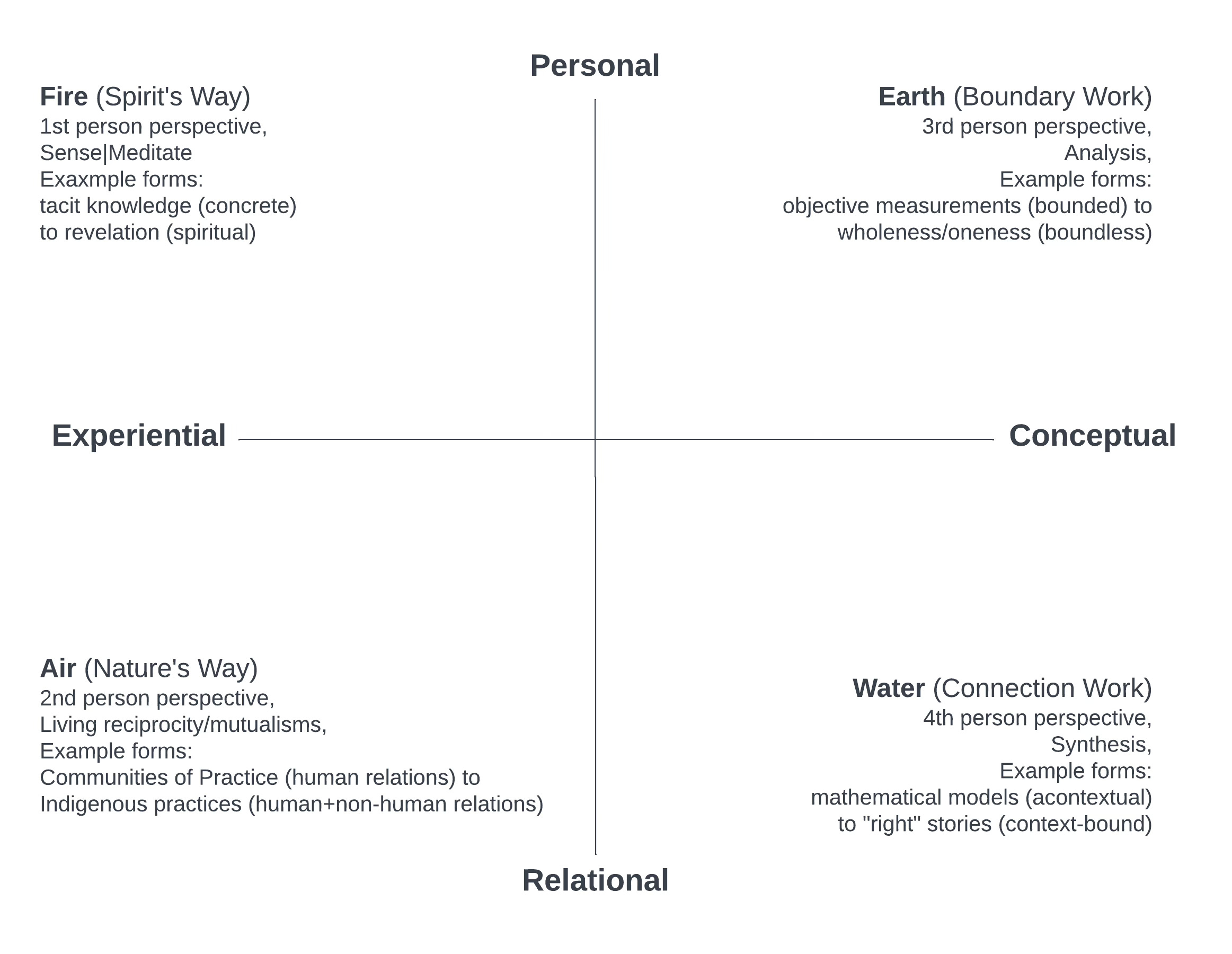
At the heart of this project is a framework that recognizes four complementary ways of knowing, each with it’s on range of plausible forms, distinct strengths, limitations, appropriate domains of application, and—critically—different processes for adjudicating truth claims. These quadrants and the overall framework is meant to be a conceptual/methodological representation for organizing understanding and facilitating dialogue. It is not meant to offer ontological claims about how reality is fundamentally structured, though we do hope it is in resonance with other work, including developmental perspectives as well as the metaphysical foundations laid out thus for in this podcast (see Episodes Two, Three, and Four).
The Conceptual Ways of Knowing: Earth and Water (together, the Objective Way)
The Earth and Water quadrants share a common epistemological foundation: both operate through conceptual knowing and employ similar processes for adjudicating truth claims. This shared structure—what I (Eric) have been calling throughout the podcast “The Objective Way”—is what enables trustworthy scientific consensus to emerge and evolve over time.
How Truth Claims Are Adjudicated in Earth and Water
I (Eric) have been developing with scientific colleagues a framework for transforming the scientific enterprise. Central to this is to articulate a set of principles to guide scientific inquiry. Below are two of the six we are developing focused on advancing trustworthy scientific consensus, which we contend involves navigating two fundamental (both-and instead of either-or) polarities:
The Diversity|Resonance Polarity: Drawing on philosopher of science, Boaz Miller’s work, trustworthy scientific consensus requires three characteristics: social diversity (ensuring exploration of diverse hypotheses and perspectives), apparent consilience from diversity of methods—the convergence of evidence (different research methods with different assumptions leading to common conclusions)—and social calibration (structured approaches for adjudicating competing truth claims). While diversity prevents false consensus and mono-method bias (the first two factors), it requires structures to produce consensus statements (third factor) through:
Clearly specifying boundary conditions delineating when, where, and for whom phenomena and competing hypotheses are relevant
Gathering, organizing, and synthesizing the totality of relevant evidence to establish a common base for adjudicating competing hypotheses and truth claims
Employing structured approaches for managing contestation, such as carefully designed experiments that can vet competing hypotheses against one another (like the famous Bell experiment adjudicating between Bohr’s and Einstein’s interpretations of quantum mechanics), extensions of Bayes Theorem to compare hypotheses against evidence and produce probabilistic estimates for each, or the use of mathematical proofs that rule out some possibilities, logically.
The Reproducibility|Autonomy Polarity: Scientific consensus statements are inherently conditional, emerging from well-bounded areas of focus through disciplinary social construction. This conditionality establishes the need for evolution of scientific consensus based on shifts in how humans organize themselves, changes in available relevant evidence, and new understanding from varying approaches to resolving contestations. The polarity recognizes the need to continually balance the tension that emerges between the need to ensure study rigor through replications with supporting individuals and groups in challenging current conventions—recognizing that paradigm shifts (like Einstein’s challenge to Newton) require individuals to explore alternative hypotheses outside current paradigms, often guided initially by experiential knowledge, metaphors, intuitions, and other wisdom outside the realm of current paradigmatic objective knowledge (i.e., that which is part of the right-hand quadrants of the model, labeled here as Earth and Water).
These polarities establish the methodological foundation shared by both Earth and Water quadrants. The key distinction between them lies in what they conceptualize rather than how they adjudicate truth claims.
As a general note, we would argue that the immense power and trustworthiness of insights that emerge from this consensus generation process is an incredible achievement of humanity writ large. Critically, this approach has enabled a range of different disciplines and ways of knowing to develop strategies for adjudicating truth claims toward the goal of consilience, or truth claims that are supported across differing disciplines, methods, and approaches. As described in a sister text only piece, consilience across disciplines and ways of knowing is a critical aspiration that I (Eric) seek to contribute to in this project.
With this robust approach for resolving contestations of truth claims established for both Earth and Water, we now turn to the two elements of the overall “Objective Way” (right-side quadrants).
Earth (Personal-Conceptual): Boundary Work
Overarching Concern: The Earth quadrant represents “boundary work”—the creation, refinement, communication, and manipulation of concepts that occur between humans. This is fundamentally about how we establish and work with conceptual distinctions that allow us to perceive, describe, and share understanding of different aspects of reality.
Perspective: Earth operates from a third-person perspective, enabling objective analysis and measurement of phenomena through concepts that can be shared across observers (and, as described in Episode 4, are also central for humans to experience reality).
Generic Process: The process centers on creating, copying, communicating and collaborating around conceptual objects (concepts, words, categories that stand for aspects of reality), establishing boundaries that distinguish one concept from another, and, as needed to enable effective communication and collaboration in relation to a concept, developing increasingly precise definitions and protocols for enacting the concepts (e.g., measurement strategies, procedures, practices, etc) that extend our collective capacity to perceive and communicate about reality (including physical, social, and spiritual facets of reality).
Range of Forms: The forms this epistemic quadrant takes vary widely based on what communities focus their attention upon and the degree of precision they require for effective communication. All human cultures leverage this quadrant since all use language and representational systems to communicate. The distinctions between cultures and communities emerge from what they direct this concept-creation capacity toward and how deeply they engage in creating ever more refined and precise usage of those concepts.
Example Forms and Their Dimensional Extremes: On one end, we find bounded concepts exemplified by objective measurements—the highly constrained, precisely defined concepts central to reductive physical sciences. Think of measurements like temperature in Kelvin, molecular weights, or the precisely bounded categories of elements in the periodic table. Here, earth (lowercase) represents the physical, bounded nature of concepts—like rocks and soil, these are discrete, measurable, clearly delineated. These reductive approaches function by establishing boundary objects that can be translated into objective measurements through procedures that extend human perception or can be stored and manipulated. On the other end, we find boundless concepts that reach toward ultimate wholeness and oneness—concepts like God, transcendence, eternal witness consciousness, Turiyarita, Samadhi, unconditional love, infinite, zero, universe, cosmos, and Mother Earth (uppercase). These concepts, while still linguistic tools requiring boundaries for communication, point toward that which encompasses everything, the unbounded ground of being itself and, thus, by definition, recognize that the concepts are only partial representations of that which is being sought to be represented.
The Double Meaning of Earth/earth: We call this quadrant “Earth” to honor both dimensions of conceptual work and to acknowledge the common cross-cultural pattern of recognizing four elements. The double meaning is intentional: earth (lowercase) signifies the bounded, material nature of precise concepts—the rocks and soil that can be measured, categorized, and manipulated. Earth (uppercase) represents our planetary mother who birthed and holds all of us—the boundless, encompassing whole that transcends any single measurement or category. This duality reflects the full range of conceptual work, from the most reductive analysis to the most expansive synthesis of oneness.
Application Across Cultures: Any time language and other representational systems are being used, this quadrant’s gifts are being drawn upon. Thus, in all human cultures, given all use some type of language and concepts, there is use of this quadrant’s gifts. Critically, all concepts, given their orientation as language tools, are definitionally cultivated in relation between humans as they are meant to help humans communicate. Thus, they emerge from personal and relational experiences (left hand quadrants) in a both-and type of dynamic (this was all implied in Episode 4).
With this general pattern articulated, Earth, at its most basic level, is the creation of concepts and representations of some facet of reality (including both physical and social realities, see Episode 4, and, aligned with the other quadrants, also spiritual reality concepts, such as the boundless concepts shared earlier). This capacity to create, communicate, copy, and collaborate around concepts is used and leveraged across all cultures, and this logic is in resonance with what we know from contemporary neuroscience (see Episode 4). Given the sub-dimensionality of both different focus and also the degree of precision of the concept, the array of possible concepts is likely infinite.
To give but one example, reductive physical scientific methods (e.g., physics, chemistry, biology), with their focus on understanding material aspects of reality, coupled with their strong commitment to ever finer perceptual capacity regarding elemental concepts (e.g., rocks to molecules to atoms to quarks), represent a valuable and important example of communities of people (in this instance, humans committed to and engaging as part of a relational network of a discipline) working together. Thus, this capacity, within these disciplinary communities based on their focal concern and their commitment toward precision, has resulted in: (a) creating conceptual objects (concepts, words, categories that stand for aspects of reality); (b) isolating specific phenomena by drawing boundaries around them; and (c) developing replicable procedures for measurement that others can repeat using instruments that capture observable, quantifiable aspects of reality. This is commonly labeled reductive scientific methods and, hear, could be thought of as a reductive earth activity.
Strengths: At its most basic, this area involves the exploration of boundaries, both in their creation and destruction, that manifest in the form of concepts, particularly words and other ideas. Each community of people, given their focal area and level of interest in precision regarding the capacity to communicate, develops varying repertoires of concepts to communicate and understand their focal area of concern.
For example, reductive methods function by establishing boundary objects (concepts) that can be translated into objective measurements (procedures that extend human perception or can be stored and manipulated). In addition, there is often a strong drive toward seeking the most “fundamental” element (e.g., see this image visualizing the “reductionist valley” within biological sciences, which we drew from here (note the “emergence” side of the “valley” is what we are labeling in this framework the “Water” quadrant, representing systems science; thus, this “valley” is one possible visualization of the right quadrants with the reductionism side on the upper right and the emergence side on the lower right):
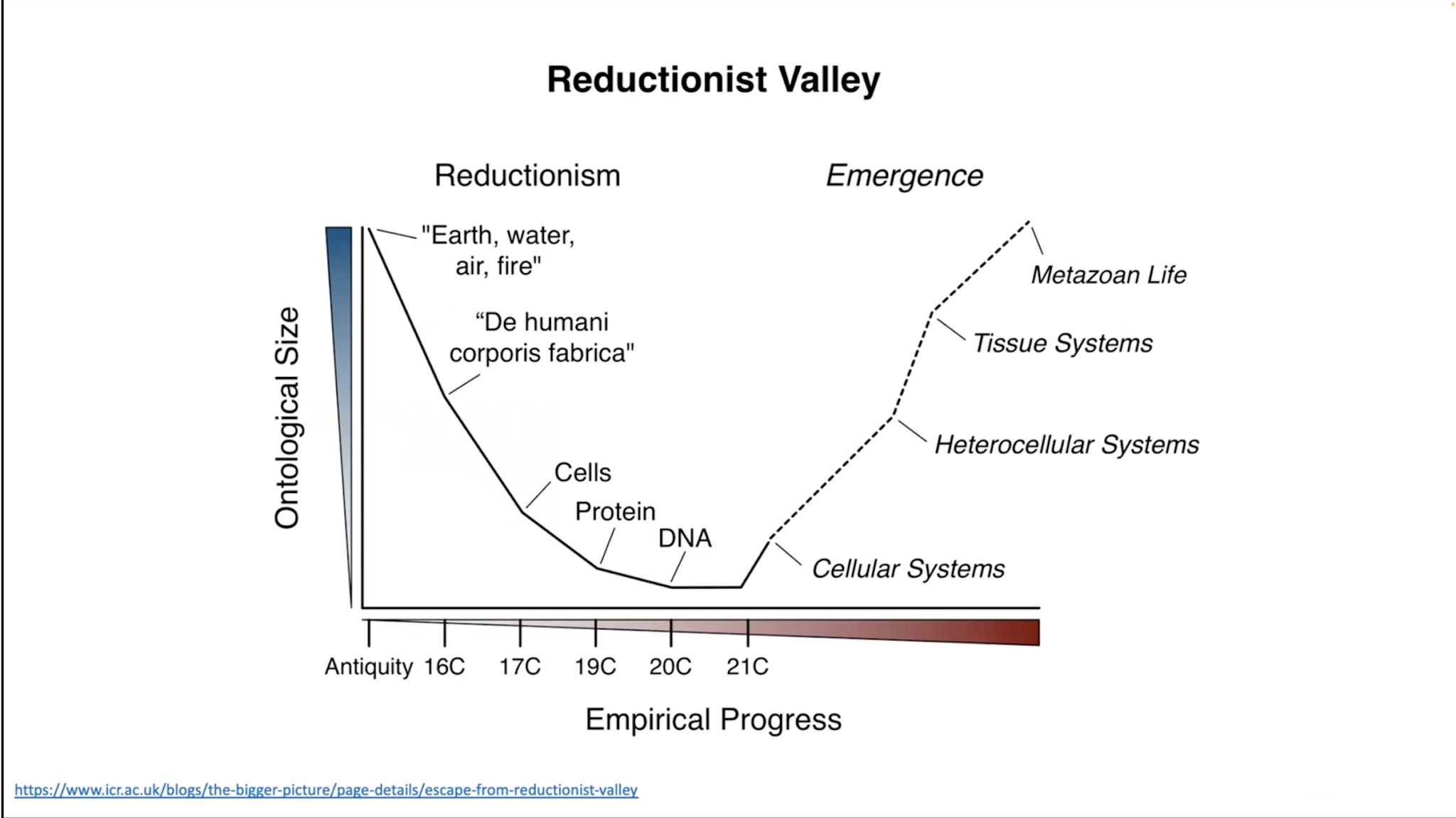
Image above from here: https://tape-lab.com/blog/2016/8/25/escape-from-reductionist-valley
We might label this reductive approach classically used in physics and otherwise as Newtonian thinking (see this episode discussion with Geoscientist Marcia Bjornerud for more on this) to signify science seeking universal and timeless truths. Critically, there is a strong focus on seeking to articulate objective essences, meaning the smallest fundamental elements that, if understood, the logic goes, could then be systematically reconstructed to understand all other elements that are built upon this foundational essence (this is likely a core drive behind string theory theorists, and is discussed in the final chapters of Timothy Palmer’s book, The Primacy of Doubt, whereby he makes the case that reductive essentialism may be a dead end for physics). This, particularly when coupled with the systems thinking tools and approaches (thus, what has been labeled “The Objective Way” in this podcast and is now more formally represented and described in the right hand quadrants), has enabled the veritable explosion in engineering and technological capacities that we experience today.
Overall, Earth ways of knowing can produce trustworthy scientific consensus statements rigorously vetted and independently verified within the boundaries of the focus for a given discipline/group working together. The great gift of this, within a community/discipline, is ever-increasing perceptual precision around some facet of reality (going down the reductive valley as visualized above). The added gift, if robust strategies can be created to support effective translation between communities (which is a key focus of this work), is that, across humanity and human history, we have a vast array of concepts we could feasibly draw upon to help us navigate and understand reality.
Limitations: By necessity, concepts work with boundaries and thus always produce “maps of territory” and are not the territory itself. When used in isolation, they struggle with emergent properties, experiential knowledge, and phenomena resisting isolation. The very act of drawing boundaries excludes context and relationship on one end. If not careful, they also can drive one toward seeking ever-smaller elements, thus driving one to the proverbial “missing the forest for the trees” phenomenon. On the other end related to the erasure of boundaries, this can result in flattening and washing out potentially valuable and meaningful variation and diversity that the boundaries enable perception of, or the flip side (missing the trees for the forest).
Reliable sources: Expert consensus from a community/discipline in relation to their focal area of concern, peer-reviewed, replicated objective truth claims that are built upon the reliability and trustworthiness of the community/discipline’s capacities.
Gift offered: Precise concepts representing bounded aspects of reality that can be leveraged and replicated by others. From reductive methods (particularly when linked with systems science methods from Water), this has enabled the production of technologies and physical reality claims primarily (for more on physical vs. social reality, see Episode 4).
Boundaries for Truth Claims: Earth, particularly the use of it that leverages reductive approaches to concept creation, is best suited for making truth claims about measurable, bounded phenomena replicable across independent observers, and has been particularly strong around physical reality phenomena (with the possibility of extending to social reality phenomena, a key area of my own scientific research—see my Google Scholar page for papers in this domain, though this extends beyond the scope of this introduction). Reductive Earth methods excel at answering “what is” questions about physical reality phenomena—the melting point of ice, the distance to the moon, the chemical composition of water. However, reductive Earth reaches its limits when addressing meaning, purpose, subjective experience, values (”what should be”), or emergent wholes resisting isolation and reduction. Reductive Earth can describe the neurochemistry of meditation but cannot adjudicate whether the oneness experience is “real” or meaningful. It can measure prayer’s physiological effects but cannot determine whether prayer reaches the divine. When reductive Earth makes claims beyond its boundaries—such as “consciousness is nothing but neurons firing” or “love is merely oxytocin”—it engages in reductionist overreach, mistaking the map (measurements of correlates) for the territory (lived experience and meaning). This point is explored in the famous “Mary’s Room” thought experiment in philosophy.
And, on the flip side of this, traditions that focus on boundless concepts (God, unconditional love, Christ Consciousness, emptiness, etc.) offer the concepts that enable people with appropriate realized wisdom to be able to communicate about these experiences to those who have not experienced this. This enables the creation of instructions on practices to try as well as pointing-out instructions that can guide another person who is interested in experiential understanding of that which these boundless concepts point toward. On this front though, these boundless claims could result in overreach when subtleties that do come into perception actually do matter when focusing on some facet of reality. Thus, just as there is a risk of overreach of reductive Earth approaches, there is a risk of overreach of what might be labeled here transcendent Earth approaches that may artificially wash out and diminish meaningful variation and distinctions that are only observable to a person with the aid of certain boundaries afforded by the use of concepts.
Water (Relational-Conceptual): Connection Work
Overarching Concern: The Water quadrant represents, at its most fundamental level, a focus on exploring and creating connections between concepts—hence the notion of “connection work.” This is about understanding how concepts relate to one another, how they interact dynamically over time, and how patterns emerge from these relationships.
Perspective: Water operates from a fourth-person perspective, enabling synthesis across multiple viewpoints and the modeling of complex relational dynamics that transcend any single observer’s vantage point.
Generic Process: The process centers on connecting concepts to reveal patterns, relationships, and emergent properties. This involves creating narratives, models, and simulations that capture how elements interact and influence each other over time—from simple causal chains to complex computational models of interconnected systems. The work is fundamentally about synthesis—putting concepts together to understand wholes that are greater than the sum of their parts.
Range of Forms: Just as with the Earth quadrant, Water ways of knowing are utilized across all cultures and communities that employ language and storytelling as a way of structuring connections between words and concepts. Different communities orient toward different foci and require different levels of precision for understanding connections between concepts, based on their communicative needs, areas of concern, and the broader contexts the live within and the corresponding pressures that emerge for individuals and communities to adapt to.
Example Forms and Their Dimensional Extremes: On one end, we find mathematical models—acontextual, abstract representations that aim for universal applicability across contexts. These are exemplified by systems science approaches that leverage concepts and objective measures from reductive Earth methods but focus on relationships, patterns, and emergence rather than isolated parts. Think of differential equations describing population dynamics, network models of information flow, or computational simulations of climate systems. Here, water (lowercase) represents the universal flow—the mathematical relationships that could apply anywhere, disconnected from specific place or time, like the molecular structure of H₂O that remains constant whether in a puddle or an ocean. On the other end, we find “right stories”—deeply context-bound narratives that are explicitly tied to particular people, places, and times. These are exemplified by Indigenous storytelling practices that maintain relationship with specific lands and living communities (e.g., see Tyson Yunkaporta’s book, Right Story, Wrong Story). Here, Water (uppercase) represents the specific bodies of water that enable life in particular places—this watershed, this river, this ocean—irreducibly bound to the communities and ecosystems they sustain.
The Double Meaning of Water/water: We call this quadrant “Water” to honor both dimensions of connection work. The double meaning is intentional: water (lowercase) signifies the universal, acontextual nature of abstract models—the flow of H₂O molecules following physical laws regardless of location, the mathematical relationships that hold anywhere and anytime. Water (uppercase) represents the specific, life-giving bodies of water that sustain particular communities and ecosystems—the rivers, lakes, and oceans that are irreducibly context-bound, whose stories are inseparable from the land and life they nourish. This duality reflects water’s nature as both universal solvent and particular place-maker, both abstract connection and embodied relationship.
Application Across Cultures: Just as with Earth ways, Water ways of knowing are utilized across all cultures and ways of knowing that employ language and storytelling. The use of narrative to connect concepts, to explain how things relate and change over time, is universal to human meaning-making. What varies is the focus of attention, the degree of abstraction pursued, and the commitment to either acontextual universality or context-bound particularity.
For example, in systems science, there is a strong focus on leveraging the range of concepts that have been produced across the physical and social sciences and finding ways to create robust system models, with ever-greater precision through mathematics, modeling, and simulations, for creating understanding of—and, by extension, use of—these connections. This is described well in the area of systems science (for a wonderful introductory text about this, please see Mobus and Kalton’s Principles of Systems Science and, for a historical review, consider James Gleick’s classic: Chaos: Making a New Science). This could be thought of as Systems-focused Water work. Systems-focused Water represents ways of knowing that leverage all of the concepts and corresponding objective measures articulated via reductive Earth approaches but, critically, focus on relationships, patterns, and emergence rather than isolated parts.
The use of “Water” as a fundamental element provides visual analogy both in a reductive sense—water (lowercase) flows in and around earth in constant exchange, fostering relationships, patterns, and emergence—and in a holistic sense—Water (uppercase) as an indicator for all the oceans and waters across the planet that enable life to emerge in specific, context-bound ways.
We might label Systems-focused Water as Darwinian thinking (see this episode discussion with Geoscientist Marcia Bjornerud for more on this) to signify science that acknowledges constant change across space and time. This way of knowing creates narratives, models, and simulations capturing how elements interact and influence each other over time, from simple causal chains to complex computational models of interconnected systems. For example, consider the ways in which observations of galaxies are made and then simulation models are run that make varying assumptions about the presence or absence of black holes at the center of galaxies. This work is used to illustrate that the observed patterns of galaxies can only be replicated in simulation models when the black holes are present, thus providing simulated evidence of their existence (which is corroborated by consilient evidence gathered from observations made in relation to the movement of stars near the center of our own Milky Way Galaxy).
Critically though, there are other Water ways, such as Indigenous practices of storytelling that are explicitly place-based and relational between living beings (e.g., see Yunkaporta’s book, Right Story, Wrong Story). The process of connecting concepts is similar, but the focus, context, and required precision for understanding connections shifts. These “right stories” are inseparable from the particular people, place, and time in which they emerge and to which they remain accountable.
Strengths: Water ways of knowing reveal patterns invisible to Earth ways of knowing, show how components interact to produce emergent phenomena, and enable prediction through modeling dynamic relationships. Particularly for Systems-focused Water, it bridges between reductive science and holistic understanding. Another key strength of methods used in this quadrant, including both storytelling and more refined forms like mathematics and systems science methods, is that they foster the emergence of new possibilities, ideas, and insights that might not be immediately obvious based on pure observation. For example, consider the famous Dirac equation formulated by Paul Dirac, which, as Dirac himself said, was smarter than he was, in that it pointed to the possibility of something he had never dreamed of: anti-matter.
Limitations: Models (e.g., stories, mathematical equations, computational models) connecting concepts are always simplifications; the map is not the territory. Most critically, all types of systems and narratives can become so abstract that they become untethered from reality. This can occur with simple stories, narratives, and explanations that emerge from any culture, including, at the extreme, rich and complex systems models. Thus, the key risk of storytelling and simulations is the creation of social reality structures, narratives, and beliefs that are logically coherent systems internal to themselves but fundamentally detached from reality. This has been called both simulacra and hyperrealities. At their core, they rely on concepts rather than direct experience to be tethered to reality, thus creating their great vulnerability.
Reliable sources: Validated predictive models that have been carefully compared with robust measurements of reality, simulation results, pattern analysis.
Focus: Relationships, connections, emergence.
Gift offered: Understanding and emergence through representing relationships and tuning between conceptual elements (both concepts and measures).
Boundaries for Truth Claims: Water can build robust truth claims about patterns, relationships, and dynamics between concepts—how systems behave, what feedback loops emerge, and how components interact over time. However, Water’s truth claims are contingent upon the quality of the evidentiary inputs (i.e., the concepts) upon which they are based. If there is either no tethering to experiential knowledge (e.g., what might be labeled “wrong story” in that the story becomes untethered to the people, place, and time when it was told, as described in Tyson Yunkaporta’s book, Right Story, Wrong Story) or if the foundational objective measures from reductive Earth methods are poorly defined or not well connected to actual reality, then the results and insights gleaned from the stories are less likely to be trustworthy. In addition, if different objects/concepts/observations from different people or communities are utilizing different ontological assumptions or created by different traditions with incompatible boundaries, systems models may appear coherent while actually combining incommensurable elements. Taken together, this is the classic “garbage in, garbage out” problem in mathematics and systems science: Water has no inherent way to assess the quality or compatibility of its conceptual inputs (though humans can feasibly integrate corrections, but that is the critical element of incorporating humans’ “tacit knowledge“ into the system).
This issue gets further complicated as different communities may seek to communicate and create shared understanding. Different communities may use the same word (e.g., “health,” “freedom,” “progress”) with fundamentally different meanings, and systems models combining these without careful ontological work (in both the philosophical and information science sense, but more so the information science sense of seeking to ensure that people can communicate via having the same shared meaning for a word) will produce coherent-seeming but misleading results. Put more simply, Water excels at revealing how concepts relate if concepts accurately represent reality, but cannot independently verify whether they do—that adjudication requires the other ways of knowing.
The Experiential Ways of Knowing: Fire and Air (Spirit’s Way and Nature’s Way)
The Fire and Air quadrants share a foundation in experiential knowing—direct, embodied understanding that cannot be fully captured through conceptual representation, while simultaneously supported by concepts. However, the processes for adjudicating truth claims in these quadrants, at least to the best of our knowledge (and we would truly welcome being corrected!), are less formally codified than in the conceptual quadrants described above and thus remain open areas of inquiry for future work in this Negotiating Reality project. (If anyone reading this has strong knowledge in these areas, we would truly welcome dialogue and invite you to join me (Eric) on a negotiation episode for the podcast.)
Fire (Personal-Experiential): Spirit’s Way
Overarching Concern: The Fire quadrant, at its most fundamental level, represents knowing through personal, direct experience. This is about what can only be known through first-person engagement with reality—the embodied, lived understanding that cannot be fully captured through conceptual representation alone, though it is simultaneously supported by concepts that help point toward and communicate about these experiences (see Episode 4).
Perspective: Fire operates from a first-person perspective, grounding all knowing in the irreducible reality of direct personal experience—what I sense, meditate upon, and come to understand through my own engagement with reality.
Generic Process: The process centers on sensing, meditating upon, and refining one’s capacity to attend to and discern direct experience. This involves disciplined cultivation of awareness and presence, often through sustained practice over time, developing the ability to perceive subtle dimensions of reality that cannot be accessed through conceptual mediation alone.
Range of Forms: Just as with the Earth and Water quadrants, Fire is utilized across all communities, cultures, and traditions. All persons develop knowledge through personal experience. What varies is the focus of attention—what facets of reality persons direct their experiential awareness toward—and the degree of refinement and precision they cultivate in their capacity to perceive and discern subtle dimensions of experience.
Example Forms and Their Dimensional Extremes: On one end, we find tacit knowledge—the concrete, embodied know-how developed through repeated practice and engagement with specific tasks or domains. This is the scientist perfecting their craft in being able to effectively use an assay to measure a phenomenon, the musician’s fingers knowing where to go without conscious thought, the athlete’s body understanding how to move. As described in Michael Polanyi’s Personal Knowledge, this tacit knowing forms the experiential foundation upon which all conceptual knowledge ultimately rests. Here, fire (lowercase) represents the embodied, experiential knowledge gained through living—the heat of engagement with material reality, the concrete practice that builds competence and skill. On the other end, we find revelation—direct experiential knowing of spiritual dimensions of reality accessed through meditation, prayer, and other consciousness-based practices central to contemplative and mystical traditions. This is the direct encounter with transcendent dimensions of reality—experiences of oneness, unconditional love, eternal witness consciousness, or what various traditions call God, Source, Buddha-nature, or the Absolute. Here, Fire (uppercase) represents guidance from Source—the eternal witnessing consciousness and unconditional love that illuminates all experience, the sacred fire that has inspired humanity’s spiritual wisdom traditions across cultures and throughout history.
The Double Meaning of Fire/fire: We call this quadrant “Fire” to honor both dimensions of personal experiential knowing. The double meaning is intentional: fire (lowercase) signifies the concrete, embodied heat of living—the tacit knowledge built through engagement, the experiential capacity to perform tasks like scientific activities, music, or sports, the muscle memory and practical wisdom that comes from doing. Fire (uppercase) represents the sacred flame—guidance from Source, the eternal witnessing consciousness and unconditional love that spiritual practitioners across traditions have encountered through disciplined contemplative practice. This duality reflects fire’s nature as both the immediate heat of embodied engagement and the transcendent light of spiritual illumination.
Application Across Cultures: Fire, in particular, is being developed collaboratively with Kabir Kadre, President of the non-profit organization Open Field Awakening and others in the Open Field Awakening group. Kabir (who is a co-author of this piece) is a long-term member and practitioner within the Integral community with a strong personal and spiritual practice aligned with this quadrant. Indeed, much of what is written below for this quadrant emerged from discussions within the container of Open Field Awakening, such as dialogues between Kabir, Richard Flyer (described below), and myself.
Strengths: For persons focusing on more explicitly bounded facets of reality (e.g., the sorts of areas of inquiry that occur within physical and, to some extent, social sciences), this personal experiential insight, particularly when working in healthy resonance with all the ways of knowing, becomes a powerful pathway for the creation of objective measurement strategies in the form of procedures that can be repeated precisely by other scientists. Thus, it provides the foundational tethering to reality that feeds and enables the Objective Way approach to adjudicating truth claims about phenomena that can fit into this structure.
For persons focused on more explicitly boundless facets of reality, the meditative and contemplative refinements to this way of knowing enable accessing dimensions of reality unavailable to external measurement. It can enable personal experiences about the nature of consciousness itself, enable transformation of the knower, and provide direct insight into meaning, purpose, and value. It offers wisdom about how to live well, what truly matters, and how to respond to suffering.
Limitations: First-person experience cannot be directly verified by others, save unless that tacit knowledge is translated into a replicable procedure mediated by all of the conceptual work in the right-hand quadrants. Particularly for Contemplative Fire orientations, without discipline, discernment, and often a teacher, contemplative knowing can slide into delusion or wishful thinking. It is deeply susceptible to “false prophets” who claim to be enlightened teachers but are not. It requires years of practice to develop reliability. Different traditions sometimes make incompatible claims, and there is no simple way to adjudicate between them using meditative methods alone.
Reliable sources: On one end, deeply disciplined individuals capable of abduction—the translation of experiential understanding of a phenomenon into a concept that can be proceduralized; on the other end, God, Realized teachers, transcendent experience, convergent wisdom across traditions.
Gift offered: Awareness, presence, and direct experiential wisdom (bliss).
How Truth Claims Are Adjudicated in Contemplative Fire: Based on initial explorations, particularly with Richard Flyer, we offer several proposed principles for adjudicating truth claims in contemplative Fire (as the more tacit knowledge Fire approaches ultimately get adjudicated via the Objective Way process described above). The rest are hypotheses to be tested in dialogue with others:
Radical Humility Regarding Translation: While first-person revelation is definitionally true as experiential reality for the person who experiences it, the translation of that revelation into words, concepts, and explanatory frameworks must be held with profound humility. In a conversation with Eric, Kabir, and Richard, we explored the paradox of revelation—that the universal is always entangled with the particular—must be navigated. While the experiential core can be absolute, its conceptual expression is always conditional on the person’s history, lineage, and culture.
Relationship as Primary Adjudication Structure: Truth claims in Fire are validated not through impersonal procedures but through sustained relationship over time. As Richard articulated: “I’ve come to trust that the more intimate and luminous a truth is, the more gently it must be carried across difference.” This points to the possibility that adjudication happens through:
Being in sustained relationship with realized teachers whose lives demonstrate the wisdom they profess
Participating in communities of practice where claims can be tested through one’s own direct experience
Observing whether teachings lead to genuine transformation (reduced suffering, increased compassion, deeper peace) across multiple practitioners over time
Maintaining accountability to lineages and traditions that have refined practices over generations
Frequency-Based Reasoning About Applicability: Rather than claiming universal applicability, Fire’s truth claims can be understood through what might be called “population-based” reasoning—acknowledging that different spiritual paths and revelatory truths resonate with different populations based on culture, context, and lived experience. This allows honoring the absolute truth of one’s own and one’s tradition’s expression of revelation while recognizing it may not be experienced in a similar fashion among other spiritual traditions. This possibility is beautifully expressed in Islam via the notion of the 99 faces of God, as described in A. Helwa’s Secrets of Divine Love. Overall, this point is critical as it enables a pathway for honoring the potential universal commonalities of revelation across cultures and traditions while also recognizing that the form these personalized revelations manifest in each person or community may, on the surface, look quite different. (As is commonly shared in Christian communities, The Lord works in mysterious ways; O Magnum Mysterium).
Drawing Supportively from Objective Way: Fire can draw on Earth and Water’s methods to support (but not replace) its truth claims—using frequency estimates of population alignment, empirical observation of practice outcomes, historical documentation of convergent testimony across traditions. For example, one could imagine the use of Earth approaches to seek to describe exactly when, where, and for whom various revelatory experiences manifest in different communities and cultures, and to then engage in epidemiological types of studies to determine the incidence and prevalence of those types of experiences in communities and to see if there are correlations of praxis and lineages that produce or do not produce said revelations. Critically here, the core adjudication must remain experiential and relational rather than purely conceptual, as the core tethering. Thus, this type of approach must be done carefully and in a container of good relationship, humility, curiosity, and compassion to ensure the Objective Way tools are calibrated such that they truly honor the experiential ways of knowing.
Convergent Testimony Across Traditions: Drawing upon Objective Way tools, if done in careful honoring and understanding of the inherent experiential nature of the phenomena itself, then it might open up interesting pathways for supporting different spiritual traditions to see patterns and resonance across spiritual traditions. Specifically, when multiple independent spiritual traditions, using different practices and arising from different cultures, report similar experiential discoveries (e.g., experiences of oneness, unconditional love, transcendent peace), this represents a form of consilience—different procedures aligning on a common conclusion. The more different spiritual traditions align on common conclusions, the more it supports the claim that these phenomena may be reliable features of consciousness accessible through disciplined practice. That said, in line with the inherent conditional nature of any verbal claims (and thus, conceptual/representational claims), these claims cannot be viewed as absolute and instead are conditional and open for revision, just as is the case with any claims that are reliant on the Objective Way approaches (Earth and Water).
Open Questions for Exploration: The Contemplative Fire quadrant invites ongoing inquiry into several critical areas. How do we distinguish mature from immature spiritual claims? How do different traditions’ incompatible metaphysical claims (theism, panentheism, non-theism, atheism) relate to potentially shared experiential cores? Can “experiential sensors”—collections of disciplined practitioners using shared methods—begin building consensus analogous to scientific consensus? What role should criteria like “reduced suffering” and “increased compassion” play in validating spiritual claims? How do we identify and address “false prophets” and spiritual harm? How also do we separate the influence of spiritual praxis from the religious institutions meant to nurture said spiritual praxes? These questions require the kind of sustained, careful dialogue that we hope to facilitate in the future in the Negotiating Reality space.
Boundaries for Truth Claims: Contemplative Fire can make strong truth claims about first-person phenomenological reality—what is directly experienced through disciplined meditative and contemplative practice. Claims like “I experience peace in meditation,” “I feel divine love,” or “I know oneness through sustained practice” are legitimate truth claims within Fire’s domain and do not require external verification. Instead, they are true for that person and their personal experience and, for them, this truth can be unconditional and universal. While that might be true and a universal type of personal experience, it is up to each person to do the work of discovering this truth or not, on their own, hence the critical limit to this way of knowing.
Contemplative Fire reaches its limits when making empirical claims that move into concepts being transferred and thus move into Earth and Water domains—claims such as the age of the universe, the efficacy of prayer for healing disease, or factual assertions about historical events all move into the realm of that which can be tested via Objective Way (Earth/Water) approaches. When Fire makes claims about that which can be translated into an objective, measurable tool, Earth and Water’s methods must be incorporated to foster adjudication of these claims, particularly an exploration of when, where, and for whom these claims may or may not be valid. Critically though, Earth/Water claims cannot overstep into claims that are beyond their areas (see above).
An intriguing possibility: if Earth and Water communities facile at the work of adjudication can learn to recognize Contemplative Fire’s disciplined, replicable first-person procedures (an area of interest among those interested in consciousness, such as Phillip Goff and also articulated by Dalai Llama in his book, The Universe in a Single Atom)—carefully articulated practices others can follow (like protocols in experimental science)—collections of practitioners serving as “experiential sensors” might begin building shared understanding of ontological claims. Just as objective scientific consensus emerges from multiple independent observers using shared methods, spiritual consensus might emerge from multiple independent practitioners using shared methods. However, this requires far more sophisticated integration between ways of knowing than currently exists. Until such integration is achieved, Contemplative Fire’s ontological claims remain difficult to adjudicate beyond phenomenological experience, bounded by Fire’s inherently personal structure.
Air (Relational-Experiential): Nature’s Way
Overarching Concern: The Air quadrant represents knowing through living relationship and embodied participation—what we understand by being in reciprocal exchange with other living beings and the more-than-human world. This is fundamentally about how we come to know through sustained mutual relationship, through being accountable to and learning from the living systems of which we are a part.
Perspective: Air operates from a second-person perspective, grounding knowing in the living reciprocity and mutualisms that emerge between beings in relationship—the “I-Thou” encounter, the understanding that arises from genuine meeting and sustained participation with others.
Generic Process: The process centers on living reciprocity and developing mutualisms—the embodied practice of being in right relationship with other beings over time. This involves sustained participation, careful attention to feedback and response, and the cultivation of accountability to the relationships that sustain us. Knowledge emerges not from observation or abstraction but from being part of the living exchange itself.
Range of Forms: Again, we claim that this quadrant is leveraged by all living beings, including humans, and thus is a central way of knowing in all cultures across humanity. Critically, this quadrant, we argue, is unique in that it is likely leveraged not just be humans but, indeed, all of life. In some ways then, if there were to be one foundational epistemic quadrant, it would likely be this one as “our nature requires nurture” (see Episode 4). All humans develop understanding through relationship and participation in communities. What varies is the focus of relational attention and the depth of commitment to sustaining and learning from these relationships over time.
Example Forms and Their Dimensional Extremes: On one end, we find Communities of Practice—groups of people who share a concern, set of problems, or passion about a topic and who deepen their knowledge and expertise by interacting on an ongoing basis. This includes disciplinary communities working together, trade groups, or any collective organized around shared human concerns and practices. Here, air (lowercase) represents the verbal communications that flow between people—the spoken and written exchanges that enable human communities to coordinate, learn, and build shared understanding. These are fundamentally human-to-human relationships mediated by language and social practices. On the other end, we find Indigenous practices—ways of knowing that emerge from sustained relationship not just with human communities but with the more-than-human world, with land, waters, plants, animals, and ancestors. These practices recognize humans as participants in broader webs of reciprocity with all beings. Here, Air (uppercase) represents the literal exchange of breath between all living beings—we breathe in what plants breathe out, they breathe in what we breathe out, revealing our fundamental interdependence with the living world. This is knowing that arises from centuries or millennia of a people living in relationship with a particular place and all its inhabitants.
The Double Meaning of Air/air: We call this quadrant “Air” to honor both dimensions of relational knowing. The double meaning is intentional: air (lowercase) signifies the use of verbal communications to speak between people—the human capacity for dialogue, discourse, and shared meaning-making that enables communities of practice to function. Air (uppercase) represents the literal, physical exchange of air between all living beings—the breath that connects us to plants, animals, and all life, the atmospheric commons that holds us all. This duality reflects air’s nature as both the medium of human communication and the embodied interdependence of all life.
Application Across Cultures: Among persons dedicated to the physical and social sciences, this relational and experiential knowing manifests in the forms of disciplines and institutions that enable people with a common focus of interest to commune together, often with the goal of ultimately creating truth claims that are the provenance of the Earth/Water quadrants. On the flipside, we argue that this quadrant has been particularly refined and cultivated among Indigenous communities, practitioners, and epistemologies in terms of direct experiential living in right relationship that is more directly aligned with Nature’s way of connection (hence this being labeled “Nature’s Way”). In the remainder of this section, we will focus on this more Living relationality as a way of knowing and thus will be talking about Living Air as a way of knowing (referring to more Indigenous epistemologies explicitly).
Thus, the more refined uses of this quadrant’s approach include: Indigenous practices of learning through relationship with land; ecological intelligence (how living systems communicate and coordinate without conceptual mediation); and human capacity for attunement (how musicians sync in performance, how communities develop shared understanding through living together). The use of “Air” invites recognition of the embodied exchange manifesting between living beings—quite literally, we humans breathe in what plants breathe out, just as they breathe in what we breathe out, revealing a relational/experiential facet of reality known through attuning to it. This Air is both occurring in a molecular way as well as in the broad sense of the Air that holds us all (e.g., the atmosphere).
Partnership Note: This quadrant is being developed collaboratively with Chag Lowry (Executive Director of Indigenous Futures Institute (IFI) and of Yurok, Maidu, and Achumawi ancestry, who is also a co-author of this piece), ensuring Indigenous epistemologies are developed respectfully rather than appropriated, with accountability mechanisms throughout. What follows represents initial hypotheses to be explored with Indigenous partners and facilitated by Lowry and IFI.
Strengths: Relational knowing arises from being aware of and accountable to the relationships sustaining us. It reveals interdependence directly. It accesses intelligence embedded in natural systems and cultural practices evolved over generations attuned to living in right relationship. It provides the most proximal and immediate indicator of actions that could be construed as ethical or unethical as manifesting living in right relationship.
Limitations: Relational knowing is context-specific and bound to the fundamental aspects enabling living relational connection. It requires ongoing participation and can be disrupted by separation or abstraction (or, as Yunkaporta labels it, “wrong story“). It is difficult to codify or transmit outside of direct relationship. Knowledge gained from decades of relationship with a particular watershed may not apply to a different watershed.
Reliable sources: Elders, nature itself, embodied practice, Indigenous wisdom keepers.
Gift offered: Wisdom through participation and love through relationship.
How Truth Claims May Be Adjudicated in Air: Based on research into Indigenous epistemologies, particularly Narvaez and Four Arrows’ work on Restoring the Kinship Worldview and scholarship on Indigenous knowledge systems, several principles appear central to adjudicating truth claims in the Air quadrant. For the first few, we flag analogous practices used in communities of practice, particularly physical and social science disciplines. With those parallels acknowledged, there are often critical differences and so there is ripe opportunity for robust learning to take place, particularly, we would suggest, communities of practice, looking to the Indigenous practices. With that acknowledged here are some initial areas identified previously within Indigenous epistemologies that we will seek to explore collaboratively with Indigenous knowledge keepers:
Ceremonial Knowledge and Community Accountability: Indigenous epistemologies favor what might be called “ceremonial knowledge”—knowledge that sustains a ceremonial community through practices embedded in everything from ceremonies to food distribution to work distribution. Truth is adjudicated not by isolated individuals but through community processes ensuring knowledge serves collective flourishing and maintains relationships. This approach, at a high level, quite similar to the approaches for adjudicating truth claims in physical and social science disciplinary communities, though, of course, there types of ceremonies take a different form, such as writing grants, conducting experiments, engaging in the peer-review process, publishing papers, arguing and synthesizing ideas, establishing approaches for adjudicating truth claims, vetting them, producing consensus statements seeking to summarize best guesses on a focal concern, etc. For example, look to the processes that produced the IPCC reports. They are ceremonial in ways that align with the disciplinary human relational way of interaction. .
Elders and Knowledge Keepers as Authorities: Elders and knowledge keepers are the source of Indigenous knowledge, highly respected because of a lifetime acquiring wisdom and knowledge through continuous experiences and apprenticing with forebears. They are custodians of knowledge, repositories of wisdom, libraries of Indigenous communities. Truth claims gain authority not through impersonal procedures but through the person who possesses them—their demonstrated wisdom, their sustained relationship with land and community, their accountability to tradition. Again, there are direct parallels to communities of practice, with a strong influence of senior members of a field as creating a strong organizing structure for a community to explore together (see Kuhn’s classic, the Structure of Scientific Revolutions for more details).
Truth-Telling and Relational Accountability: Indigenous epistemologies emphasize “truthing” as a way of life—the strong expectation that everyone will share their truth because people depend on each other’s honesty to maintain shared ontological understandings of collective reality and the place of human beings within the web of relational alliances. (Note: within this space, Eric has been labeling this the need to show up in good faith and good will). Ceremonies such as Smudge and Pipe ceremonies entrench truth-telling as part of sacred ways (Accountability, Relationality and Indigenous Epistemology). Truth is not abstract but embedded in ongoing accountability to relationships. Again, there is a critical need in communities of practice for people to commit to act in good faith (meaning a commitment to truth). Without that foundation, communities of practice can often collapse for fail to be able to produce any sort of trustworthy consensus (for a robust review of this including the use of simulation studies to illustrate the corrosive impact of people acting in bad faith within the process of scientific consensus creation, see the book, The Misinformation Age).
Laws of Nature as Highest Rules: Indigenous worldview precepts emphasize laws of nature as the highest rules for living, with emphasis on generosity and the greater good instead of pursuing selfish goals, egalitarian rule versus hierarchical governance, and fearless trust in the universe instead of fear-based culture (Restoring the Kinship Worldview). Truth claims are validated by whether they align with observed patterns in nature and whether they support life-sustaining relationships. The notion of “Natural Laws” was a critical concept in the Enlightenment and, thus, was a critical early on concept akin to this that spurred on many of today’s disciplinary communities of practice.
While the above had some plausible linkages between Indigenous practices and communities of practice, the remainder, based on our estimation, is critical, valuable, and uniquely articulated in Indigenous practices.
“Coming to Know” Through Lived Relationship: Indigenous science uses the term “coming to know” to describe developing understanding—entering into relationship with the spirits of the people, a journey requiring individuals to personally reflect upon and conceptualize balance between their own knowing and other views (Chapter 3 – “Coming to Know”: A Framework for Indigenous Science Education). Truth emerges through sustained participation in relationships over time, not through abstraction or extraction. This knowing is validated by whether it enables survival, flourishing of all community members, and maintenance of right relationship with land and other beings.
Place-Based and Context-Specific Validation: Indigenous science is multi-contextual, coming from systems of thought reflecting how nature works “in their place”—knowledge structured with reference to particular people and place toward the goal of sustainability and perpetuation of culturally distinct ways of life through generations (Right Story, Wrong Story). Truth is always situated in relationship to location, experience, and group of people. Claims valid in one context may not transfer to another.
Holistic Integration of Four Knowledge Domains: Indigenous epistemologies identify four interconnected dimensions of knowledge—emotional, spiritual, cognitive, and physical—informed by ancestral knowledge to be passed to future generations. These four elements are inseparable, and well-being involves attending to and valuing all these realms (Indigenous Epistemologies and Pedagogies). Truth must resonate across all dimensions, not just cognitive/conceptual.
Open Questions to Explore with Indigenous Partners: The Living Air (as opposed to the Disciplinary Air relationality) ways of knowing invites sustained collaborative inquiry with Indigenous knowledge keepers into several critical areas. How do different Indigenous traditions navigate disagreements about truth claims? What role do ceremonies play in establishing and maintaining truth? How is knowledge validated when it comes from dreams, visions, or communication with more-than-human beings? How do Indigenous communities distinguish between knowledge keepers whose claims should be trusted versus those who may be mistaken? What accountability structures exist when someone makes false claims? How is “truth telling,” and, in particular, when one may not show up with a commitment to it, managed within Indigenous communities? How can Indigenous epistemologies be honored without appropriation when engaging across cultural boundaries? How do Indigenous communities determine when their knowledge should be shared versus protected? These questions require respectful, accountable dialogue that centers Indigenous voices and honors Indigenous sovereignty over their own knowledge systems.
Boundaries for Truth Claims: Living Air can make strong truth claims about relational ethics and right relationship within specific contexts—how to live well together in this place, with these beings, under these conditions. Living Air knows living and embodied relationality more deeply than other quadrants (including Disciplinary Air within this quadrant), understanding subtle dynamics of how living beings communicate, attune, and coordinate without (or at least with minimal) conceptual mediation (think, for example, of the notion of mutualisms, as explored in Rob Dunn’s Book, The Call of the Honeyguide and discussed in episode 4 and 4A with Dunn). This knowing is grounded in ongoing participation and accountability to relationships sustaining life.
However, both Disciplinary and Living Air’s truth claims are inherently context-specific and bounded by the particular relationships and places from which they emerge. Knowledge gained from generations of relationship with a specific watershed, ecosystem, or community may not generalize to other contexts. Similarly, Disciplinary relationships are bound by the lineage of people who came before and their foci, concerns, approaches and otherwise, as described most famously by Thomas Kuhn in The Structure of Scientific Revolutions. Air reaches its limits when making universal claims purporting to apply across all places, all relationships, all times—such knowing requires the abstracting capacity of Water or Earth. Indeed, there are great opportunities for more robust integration with Living Air’s ways of knowing acting as the foundational “tacit knowledge” akin to Polanyi’s Personal knowledge for reductive science but now for Systems Science.
Additionally, Living Air’s knowing can be disrupted by separation or abstraction; when relationship is severed, the knowing fades (though it can often be re-learned and re-discovered, as emphasized in Indigenous traditions). Living Air knows how this forest breathes, how this community thrives, how these beings need each other—but translating that knowing to other forests, other communities requires careful attention to whether similar relational patterns hold and is shared via transmission of right story.
Adjudicating Competing Truth Claims Across Quadrants
The question of how to adjudicate truth claims when different quadrants make competing or overlapping assertions represents perhaps the most challenging—and most important—dimension of this framework. This is not merely an academic exercise but strikes at the heart of contemporary cultural conflicts. When Earth’s scientific consensus about the universe being 13.8 billion years old (Wikipedia) appears to conflict with Fire’s revelatory understanding of divine creation as told in the Genesis creation story, or when Water’s climate models seem to contradict Air’s place-based ecological knowledge, we face genuine epistemological tensions that cannot be resolved by simply asserting one quadrant’s supremacy over others.
The good news is that the dialogue principles established in episode 1 of this podcast, combined with the within-quadrant processes for adjudicating truth claims, offer some prototype hypotheses on possible pathways through these tensions. While these remain hypotheses to be tested—and success is by no means guaranteed—the convergence of principles across quadrants offers hope that productive engagement may be possible even across profound disagreement.
Principles That May Guide Cross-Quadrant Adjudication
Drawing from both the dialogue principles and the within-quadrant adjudication processes described above, several shared commitments emerge that could provide foundation for navigating cross-quadrant conflicts:
1. Relationship as Prerequisite for Adjudication: Both the experiential quadrants (Fire and Air) and the dialogue principles emphasize that trustworthy adjudication requires sustained relationship over time. This applies across quadrants as well. When Earth claims conflict with Fire claims, productive engagement requires relationship-building between scientific and spiritual communities—not one-off debates but sustained dialogue where patterns of good faith, good will, and mutual understanding can emerge. As discovered in dialogue with Richard Flyer: the more intimate and luminous a truth claim, the more gently it must be carried across difference, and that gentleness requires relationship.
2. Humility About Translation and Boundaries: The Fire quadrant’s insight about radical humility—that the most universal experiences may simultaneously be most conditionally bound to particular personal experiences and their lineages—applies across all quadrants. Earth’s measurements are conditional on instruments and methods. Water’s models are conditional on conceptual inputs. Fire’s revelations are conditional on personal history and lineage. Air’s relational knowledge is conditional on specific places and communities. Recognizing these conditionalities creates space for dialogue rather than domination. Each quadrant should be humble about claims beyond its appropriate boundaries while confident within its domain.
3. Compassionate Understanding on Each Quadrant’s Own Terms: Before adjudicating conflicts, all parties must work to understand others on their own terms (an area elevated both from Marcia Bjornerud and Rob Dunn in our discussions). This means: scientists must genuinely understand what Fire’s revelation means and why it matters before dismissing it; spiritual practitioners must genuinely understand Earth’s methods and evidentiary standards before rejecting scientific consensus; Indigenous knowledge keepers must be understood through Air’s relational framework rather than forced into Earth’s reductive categories. This compassionate understanding may reveal that apparent conflicts are actually different ways of knowing different aspects of reality.
4. Trust Assessment Using Aligned Intentions, Capability, and Reliability: When conflicts arise, applying a trust framework (e.g., the one about to be offered is an adaptation from Staci Haines, as described in her book, The Politics of Trauma) helps localize where breakdown occurs. Are intentions misaligned (fundamentally seeking different things)? Are capabilities in question (disagreeing about methods)? Or are reliability factors creating obstacles (contextual/systematic barriers to implementation)? For example, when Earth and Fire disagree about the universe’s age, is this: an intentions problem (one seeks objective truth, the other seeks meaning and purpose—potentially incompatible goals); a capability problem (disagreeing about which methods can access which aspects of reality); or a reliability problem (institutional/social factors preventing productive dialogue)? Identifying the type of breakdown suggests different paths forward.
5. Presumption of Good Faith and Good Will: Cross-quadrant dialogue requires presuming others show up in good faith (commitment to see reality as it is) and good will (commitment to minimize suffering, seek mutual flourishing). This doesn’t mean naive acceptance of all claims, but it does mean: not dismissing scientific consensus as merely materialist ideology; not dismissing spiritual revelation as merely delusion or wish fulfillment; not dismissing Indigenous knowledge as merely primitive superstition; not dismissing systems thinking as merely abstract theorizing. With that said, it is critical to recognize the harm that manifests from persons acting in bad faith (not showing a commitment to truth) and/or bad will (not showing any commitment to the minimization of suffering, at minimum, and, ideally, seeking mutual flourishing). Violations of good faith/good will must be identified through patterns in sustained relationship, not assumed from superficial engagement, and they should be managed and navigated carefully.
6. Explicit Naming of Power, Positionality, and What Cannot Be Known: Western conceptual ways (Earth/Water) have been culturally privileged and institutionally supported in ways that experiential ways (Fire/Air) have not. This power differential shapes dialogue. Scientists speaking from Earth must acknowledge the institutional backing and cultural authority their claims carry. Indigenous peoples speaking from Air must be acknowledged for having been disrupted by colonization and thus caused intergenerational trauma and corresponding disruption of knowledge transmission that impacts their power in relation to Western persons. Spiritual practitioners, particularly those in positions of power within religious organizations, must face the ways in which their claims to be the Universal and only pathway to truth sets up great challenges with living into the practices and teachings of Jesus Christ. Systems thinkers speaking from Water must acknowledge their models’ dependence on conceptual inputs from other quadrants. Making these limitations explicit creates conditions for equitable dialogue.
Working Through Cross-Quadrant Tensions
How might these principles work in practice? Consider several paradigmatic conflicts:
Example 1: Age of Universe (Earth versus Fire): Scientific consensus based on cosmic microwave background measurements and other evidence places the universe’s age at 13.8 billion years with only 1% uncertainty (Wikipedia). Some Fire-based religious traditions understand creation as occurring thousands rather than billions of years ago based on scriptural revelation.
Applying the principles: Compassionate understanding reveals these may address different questions—reductive Earth answers “when did measurable physical processes begin?” while Contemplative Fire addresses “what is the meaning and purpose of existence?” Trust assessment suggests this is partly a capability disagreement (which methods can access which truths) rather than purely incompatible claims. Humility about boundaries means reductive Earth acknowledges it cannot address meaning/purpose questions while contemplative Fire acknowledges it makes no claims about measurable physical processes’ timing. Relationship over time allows exploring whether both can be honored: reductive Earth’s measurements stand as robust within its domain; contemplative Fire’s revelatory meaning stands as robust within its domain; the question becomes whether these domains must be seen as contradictory or whether they address different aspects of reality.
This doesn’t guarantee resolution—some Fire traditions may insist their claims are about measurable physical processes and thus directly contradict Earth. But the principles create conditions where genuine exploration of compatibility becomes possible rather than immediate dismissal.
Example 2: Climate Change (Water models versus Air place-based knowledge): Systems-focused Water’s sophisticated climate models project warming trends and policy implications. Living Air’s place-based knowledge from Indigenous communities observing specific ecosystems over generations may report changes Water’s models don’t capture or priorities Water’s abstractions miss.
Applying the principles: Compassionate understanding means climate scientists genuinely engage with Indigenous observations as valuable data rather than anecdote. It means Indigenous knowledge keepers engage with models as complementary tools rather than threatening abstractions. Trust assessment reveals this may be a reliability problem—both share intentions (address climate change) and have genuine capabilities, but institutional structures don’t support integration of both ways of knowing. Power dynamics must be named—Systems Water’s models shape policy while Living Air’s knowledge has been systematically excluded. The solution isn’t choosing one over the other but creating structures where both inform action: Systems Water’s models identify large-scale patterns; Living Air’s knowledge guides context-specific implementation and identifies what models miss.
Example 3: Healing Practices (Fire contemplative knowing versus Earth medical measurement): Contemplative Fire traditions claim prayer and meditation heal. Reductive Earth’s clinical trials show mixed or negative results for some of these practices when subjected to rigorous measurement.
Applying the principles: Humility about boundaries is crucial—reductive Earth can measure certain physiological correlates but cannot measure subjective experience of healing, meaning-making, or spiritual transformation. Contemplative Fire can speak authoritatively to first-person experience but cannot make universal claims about physical reality outcomes. Compassionate understanding means scientists acknowledge prayer may serve purposes beyond measurable symptom or root cause reduction. It means contemplative practitioners acknowledge Earth’s methods legitimately assess certain kinds of claims. The resolution may be recognizing different types of healing: reductive Earth measures physical symptom reduction; Contemplative Fire addresses existential suffering and meaning. Both are real; neither invalidates the other.
Questions for Exploration Guided by These Principles
With these principles as foundation, future work in this Negotiating Reality space and beyond (i.e., Open Field Awakening and the Indigenous Futures Institute) can explore:
Domain Clarification: For any given question, which quadrant(s) are best suited to provide answers? Are we asking about measurable phenomena, relational patterns, first-person experience, or lived relationship in place? Can we develop protocols for recognizing when we’re asking questions that require multiple quadrants?
Integration Protocols: When insights from multiple quadrants are needed, how do we integrate them without forcing one into another’s framework? Can we develop “trading zones” where different ways of knowing exchange insights while maintaining their integrity?
Handling Genuine Incompatibility: When quadrants make truly incompatible claims about the same domain (not different domains), how do we adjudicate? Do we default to the quadrant whose boundaries suggest it’s best suited? Do we hold both in tension? Do we require one to revise its claims?
Power and Access: How do we create conditions where all quadrants have equitable voice despite historical power imbalances? How do we prevent conceptual quadrants (Earth/Water) from dominating simply due to institutional backing?
Emergent Properties: What new understanding emerges when we successfully integrate insights across quadrants that wouldn’t be accessible from any single quadrant alone? What would “consilience” across fundamentally different ways of knowing look like?
Establishing a “Good Enough” Benchmark: 70% Consent Aspiration
Returning to Episode 1 and the work of James Davison Hunter, Hunter highlighted that the “agreements that hold our disagreements“ have broken down within the United States (and feasibly beyond). As flagged within Episode 1 to this podcast, a key goal is to respond to this by seeking to cultivate the agreements for holding our disagreements. If the principles described above prove effective within quadrants—if Earth/Water achieve trustworthy consensus through diversity and social calibration, if Fire achieves validation through relational accountability and convergent testimony, if Air achieves knowing through sustained relationship with place—this provides evidence that principled adjudication is possible. The 70% consent target tests whether these same principles can bridge across quadrants.
The 70% consent target represents not just pragmatic acknowledgment that universal agreement is impossible but also recognition that these assumptions themselves may not be shared by everyone—and that’s acceptable.
Not everyone will embrace epistemic humility; some will maintain certainty in their way of knowing as the only valid path. Not everyone will accept the epistemic-ontological distinction; some will insist their epistemology necessarily entails specific ontological conclusions. Not everyone will find epistemic fit useful; some will believe their method applies universally to all questions.
From an evolutionary and ecological perspective, this diversity likely serves valuable functions. The framework aims to create sufficient shared ground among those capable of these commitments (the 70%) to enable productive engagement across differences—including engagement with the 30% who hold different assumptions.
The question is not whether everyone will share these assumptions but whether enough people will to make a difference in healing polarization, enabling complex problem-solving that requires multiple ways of knowing, and creating more productive discourse across epistemic divides.
By making these assumptions explicit, we make them contestable. Perhaps epistemic humility is not necessary or sufficient for dialogue. Perhaps the epistemic-ontological distinction cannot be maintained or doesn’t serve its intended purpose. Perhaps epistemic fit introduces more confusion than clarity.
These are legitimate challenges that can be explored through the dialogue processes this framework seeks to enable. The assumptions offered here represent our best current understanding of what makes cross-epistemic dialogue possible. They are starting points, not final truths—hypotheses to be tested through sustained engagement across diverse epistemic communities.
Your role in this process matters. Whether you embrace these assumptions, find them problematic, or propose alternatives, your engagement advances the larger inquiry into how we might know together what we cannot know alone. Challenge them. Test them against your experience. Propose refinements. Join the ongoing work of discovering whether frameworks like this can help bridge divides—or clarify why such bridging requires different foundations entirely.
With these foundational assumptions articulated, we now turn to the framework itself: the four complementary ways of knowing that these assumptions enable us to recognize, honor, and integrate.
The Hypothesized Set of Agreements for Holding Our Disagreements
Epistemic humility is both pre-condition and will be reinforced by engaging with this framework.
Epistemic agreements can create the holding space for healthy dialogue around ontological disagreements.
Epistemic fit is both possible and desirable as a structured approach for starting to adjudicate truth claims both within and across different ways of knowing.
Multiple ways of knowing (conceptual and experiential, personal and relational) are valid and necessary
Each way of knowing has distinctive strengths, appropriate domains, and inherent limitations
Complex challenges require integration across multiple ways of knowing
The principles outlined above (relationship, humility, compassion, trust assessment, good faith/will presumption, power acknowledgment) can guide cross-quadrant dialogue
Where genuine incompatibilities exist, these can be acknowledged and honored without requiring coercion or domination
If 70% consent is achieved even in adversarial dialogues, it provides evidence that consilience across the science-religion divide is genuinely possible among thought leaders and engaged citizens. If not achieved, the failures will be instructive about where irreducible differences lie, which principles proved inadequate, and whether frameworks like this can bridge epistemic divides at all.
Please note that the goal is NOT 100% consent. 100% is likely only achievable through implicit or explicit forms of coercion and, given the diversity of human experiences, is not a practical or realistic goal. However, 50% is also inadequate as it perpetuates the current political polarization—continually flip-flopping between different ways of knowing that ultimately push cultures toward defining themselves more by who they are not, instead of who they are. This is called schismogenesis—the process by which groups define their identity primarily in opposition to others—in anthropology. We are consciously seeking to avoid this by setting a benchmark that is neither too low (50%) nor impossible to achieve (100%).
This remains important future work requiring the kind of cross-quadrant dialogue the Negotiating Reality podcast aims to enable, but which is not yet possible given current cultural conditions. The processes for adjudicating truth claims within the conceptual quadrants (Earth/Water) are well-established through centuries of scientific practice, validated by the scientific integrity principles. The processes within the experiential quadrants (Fire/Air) are less formally codified (at least as I (Eric) understand them, and we welcome correction!) and emerged as hypotheses through initial dialogue and research. The processes for adjudicating across quadrants are even less developed—they represent the heart of what we seek to be growing into.
Whether productive integration across all four ways of knowing is possible, whether such integration can be guided by shared principles even across profound disagreement, and whether this addresses political polarization among thought leaders and engaged citizens who shape broader discourse—these are precisely the questions this project aims to answer. The principles offered here are starting points, not final solutions. They will be tested, challenged, refined, and potentially replaced through rigorous dialogue processes. Success would mean discovering pathways through seemingly impossible conversations. Failure would mean providing further understanding on where irreducible differences may still be present. Either outcome advances our understanding of what healing political polarization requires.
Closing: An Ongoing Invitation
This framework—with its four complementary ways of knowing grounded in experiential and conceptual dimensions, personal and relational perspectives—is offered not as a finished answer but as a living hypothesis. Like the opening invitation stated, what matters most is not whether this particular framework proves “correct” but whether it serves its intended purpose: creating conditions for more productive dialogue across epistemic divides, or, to flip Hunter’s phrase, the agreements for holding disagreements.
The work ahead requires precisely the kind of engagement this framework seeks to enable. Future work in the Negotiating Reality space, in partnership with the Indigenous Futures Institute and Open Field Awakening, will test these ideas through sustained dialogue with diverse epistemic communities—scientists and spiritual practitioners, Indigenous knowledge keepers and systems thinkers, skeptics and believers. Each conversation will refine, challenge, or validate aspects of this model.
Your participation in this ongoing inquiry matters. Whether you bring deep expertise in one quadrant or curiosity about how different ways of knowing might complement each other, your critical engagement—your questions, objections, alternative framings, and lived experience—is essential. The dialogue principles outlined in episode 1 create the container: good faith, consent over consensus, playful curiosity balanced with careful thought, situated awareness, and honoring different ways of knowing.
This is an invitation to join an experiment in bridging what often seems unbridgeable. Not through false consensus or premature synthesis, but through sustained relationship, radical humility about what each way of knowing can and cannot access, and commitment to understanding each approach on its own terms before seeking integration.
The question is not whether you agree with every element of this framework. The question is whether you’re willing to explore, with curiosity and rigor, what becomes possible when we honor multiple ways of knowing as complementary rather than competing—when we recognize that the scientist’s measurement, the believer’s revelation, the systems thinker’s model, and the Indigenous elder’s place-based wisdom each offer irreplaceable perspectives on reality.
If this invitation resonates, we welcome your engagement. Challenge the framework. Test it against your own experience and expertise. Identify where it falls short. Propose refinements. Join the dialogue that will determine whether frameworks like this can help heal our fractured discourse—or clarify why such healing requires different approaches entirely.
The work of bridging epistemological divides is not easy. It requires patience, humility, and willingness to sit with discomfort and uncertainty. But the alternative—continued polarization, escalating conflict, inability to address complex challenges requiring multiple perspectives—is far more costly.
This framework, and the larger project it serves, rests on a conviction: that human beings across different ways of knowing share enough common ground to make productive dialogue possible, even across profound disagreement. That conviction itself is a hypothesis to be tested through the work ahead.
Thank you for engaging with these ideas. Whether you ultimately embrace, reject, or refine this framework, your thoughtful attention contributes to the larger inquiry into how we might know together what we cannot know alone.
For those interested in participating in dialogues, contributing critique and refinement, or exploring how this framework applies to specific domains, please reach out through the channels provided on the podcast platform. This work succeeds only through genuine collaboration across epistemic communities.
Post Script:
Now that you see this, I (Eric, and, henceforth, this is just from Eric) wanted to tag the I actually had the core picture of the Negotiating Reality image (the valley with the bridge and sun behind it) as a representation of this four element model. The valley is meant to represent the objective way overall, with the left side going down the reductive “earth” ways of knowing and the right representing the “water” way. The bridge was meant to be a representation of this actual living bridge visualized on the front page and described in detail in the Book Lo-TEK. With it, the roots of trees are connected to form a bridge and, thus, the “air” quadrant being represented. Finally, sun represents the fire quadrant, providing light to enable the others to be seen.
Here’s the very early email exchange I had with Adrienne the Substack Coach (her daughter, Sarah, created this for me! Go Sarah and thank you!).
EMAIL BELOW
I’ve got a bit of a crazy image in my head that I feel like is the “anchor” for all of this. I don’t have any artistic ability to paint it though at all.
With this, If it’s OK, I’ll try to describe it to “paint a picture” with words, abstraction visualizations to help highlight what I’m trying to represent, and then drawing in some real images to further help “paint the picture.”
With this, I’m going to describe a lot but fully get that a lot of this probably can’t be created in a way that captures all the subtlety and detail. To me, it’s more about getting the gestalt sense of this in a way that, if someone looked at the image and it feels on the verge of real and fantastical/mystical, that if they then look at this diagram, of the abstractions they are meant to represent (with then me talking through all of them over time), that they’d be able to “get” and “feel” what this a bout.
I truly have no idea if this is possible though so just putting this out there and feel free to edit, adjust, or whatever you need to make this work and be an appropriate request to send to your daughter.
With all those caveats,
here’s a conceptual diagram of what I’m trying to convey in this image and then for each of the ones, need for Substack, I’d want them to riff off of this core visual, which I’m picturing as the wide background page image. I could image something playing off the color and feel of this (e.g., very simplified valley with a bridge and sun and NR perhaps in the sun?).
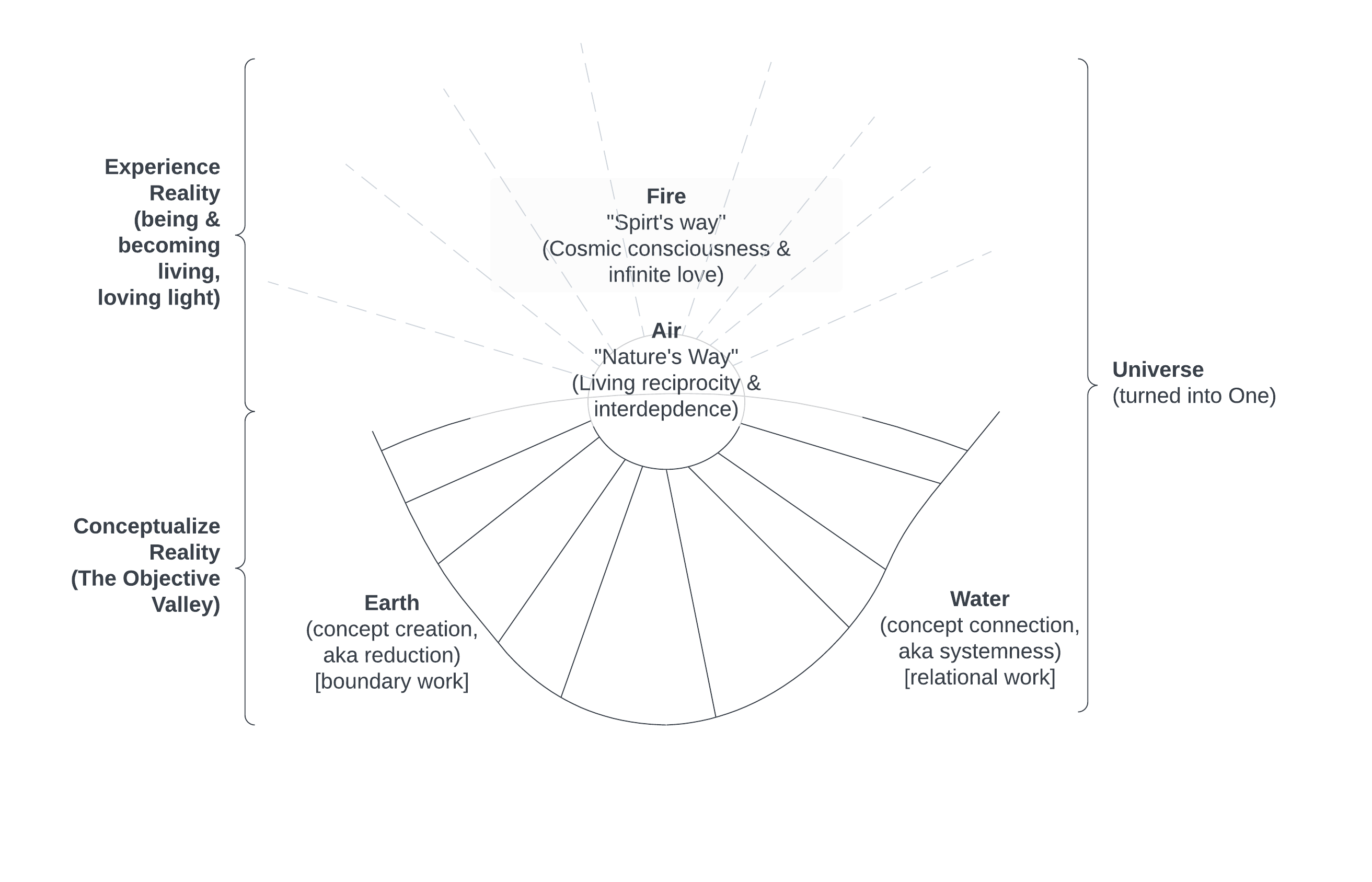
What I’d love to have created is a landscape image that is meant to visualize this as a natural while also fantastical and mystical landscape.
I’ll first describe what I’m picturing the picture could be.
First, on the left side of the valley, I want it to represent “Earth” and also, to some degree more of “Western” traditions (e.g., Europe the Americas, etc). So with this, on the left side of the Valley, I’m picturing a deciduous forest, as one might expect to see in Northeastern United States or in Europe, on the top of the valley. Going down into the valley from the left side and coming down from the deciduous forest is a path that weaves down a rock canyon, like the Grand Canyon. This side is dry and cracked, with layers upon layers of different types of earth showing the long multi-billion year history of Earth. With it, there is a walking trail that meanders down this as a series of switch-backs (if possible, path is not needed if messes with the overall feel)
On the right side of the valley is a rainforest or juggle growing on the top, as one might expect to find in parts of India, Southeast Asia, and “The East” if you will (and pictured in the image below showing the living tree bridges that actually do exist and grow in a part of India that has such strong monsoons that no m bridge made from human-made materials can ever survive, see below). Coming down into the valley from the right side, starting from the jungle, there should be a path going down that is also winding but now, on this side, it is representing water. With this, this side is wet and filled with streams, rivers, waters and the like and filled with vegetation and life.
At the very bottom of the valley there is a stream that is running out and, in the distance behind, which you can see through the valley you can see the Ocean and with the streams feeding into that ocean.
At the bottom of the valley, if possible, I’d like this part to stay in shadow as if the rays of the sun never touch it (though the water does flow out to the ocean, and the ocean reflects the sun’s rays).
This is meant to represent this “objective valley” here’s a visual describing it in relation to studying biological systems:
Next, there is a the sun, meant to represent “fire” and the light of consciousness and infinite love as that which holds and supports us all (that which “holds” space/time, if you will).
In the sky there is the sun shining bright and fiery and illuminating with streaks of light going through clouds and touching down and throw the clouds, with the clouds lit up like a brilliant sunset blanketing the world in light (if you’ve ever seen the Hudson River School of Art, like the paintings, eg. like this https://images.app.goo.gl/4DjwPJ7faJaeN4pB9though they are even fierier when seen in real life and, critically, I’d want ot make sure the sun can actually be seen and is not actually set).

Last, but not least, the focal point of it all is a natural bridge that is created through the weaving of the two very different types of roots and plants that link together the roots and trees of the deciduous forest on the left side of the valley with the roots/trees on jungle forest on the right side. This bridge is meant to represent “air” and the ways in which we live in reciprocity and inter-dependence together. The “Bridge” is made via the interweaving of these the roots from these two types of forests and, on it, it supports movement of a wide range of life. People of all ethnicities and lineages, plants, animals, birds and the like can be seen moving across and around on it, with some looking down into the valley below (and with those people looking more like scientists, engineers, technologists, and mathematicians), some looking up into the fiery sky (and these people looking more as spiritual and religious persons from across our ancient spiritual wisdom traditions such as the Abrahamic religions like Judaism, Christianity and Islam, Buddhism, Yogic practices, Taoist, and Indigenous spiritual practices). Still there is a third group who are looking at and tending to one another and to the tree and the rest of life. People can and should be visualized from a broad diversity of life from across Planet Earth, with careful monitoring of gender balance.
Here’s real living bridges that I’m holding in my mind as the example of the model of the type of bridge it could be:
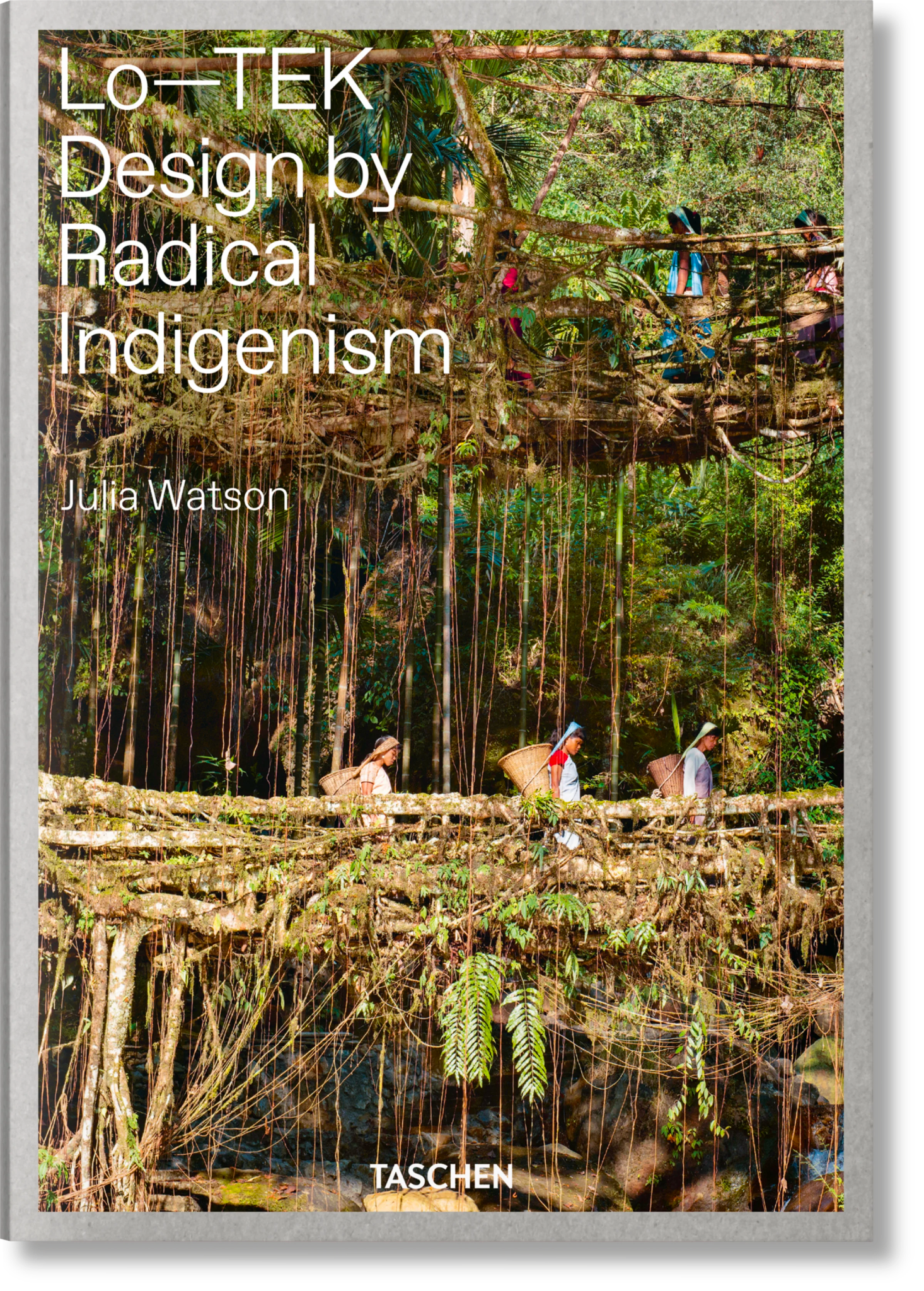
(and here’s a few more close-ups so you can get a sense of how they are made and used):
I know that’s a lot and all those details aren’t needed but I thought I’d “paint a picture in words” to try and offer some inspiration.
My goal is to have this visualization represent a living landscape that symbolizes key ways of knowing that I’m linking to the four elements:
Fire (being and becoming conscious and experiencing transcendence and unconditional love)
Air (being and becoming living, embodied, interdependent, and reciprocal beings – I chose air as a key representation of our deep embodied way of knowing our interdependence. Every time we breathe in, we are breathing in the respiration of a plant. Just as when we breathe out, we are respiring what plants breathe in. “Life breathes”)
Earth (knowing through the creation of concepts/objects and using a taxonomic logic of reduction towards cultivating a granularity of perspective, this is the classical scientific and STEM way of knowing taught most commonly in Universities today, this is, thus, the area of analysis, which literally translates to “take things apart”).
Water (knowing the potential flow of resources, information, and prestige that occurs between the objects created from the reductive/analytic/earth way of knowing and articulate how these invented objects might interact together; this is, thus, the area of synthesis, which translates to “put things together).
 | A guest post by
|
|
 | A guest post by
|
Wow, the part about the framework being a conceptual map, not the territory, really resonated with me. So often we confuse our models with reality, even in programing, wich is kinda funny. Will future episodes dive into the different levels of abstraction these maps can have?